No. 116 min read
Escaping the Binance hack cost $58m of Ethereum fees in one day
Trading volume rose 5.1 times. The premium paid for position inside a block rose 55 times.
Good morning. Bitcoin is $77,376 and flat, two days after $6,360m was taken from Binance, and spot bitcoin funds sold $643m on Friday, their heaviest day in the 42 on file. Binance has promised a full reserve report by 2 November. The number that matters is what the escape cost on Ethereum.
The tape
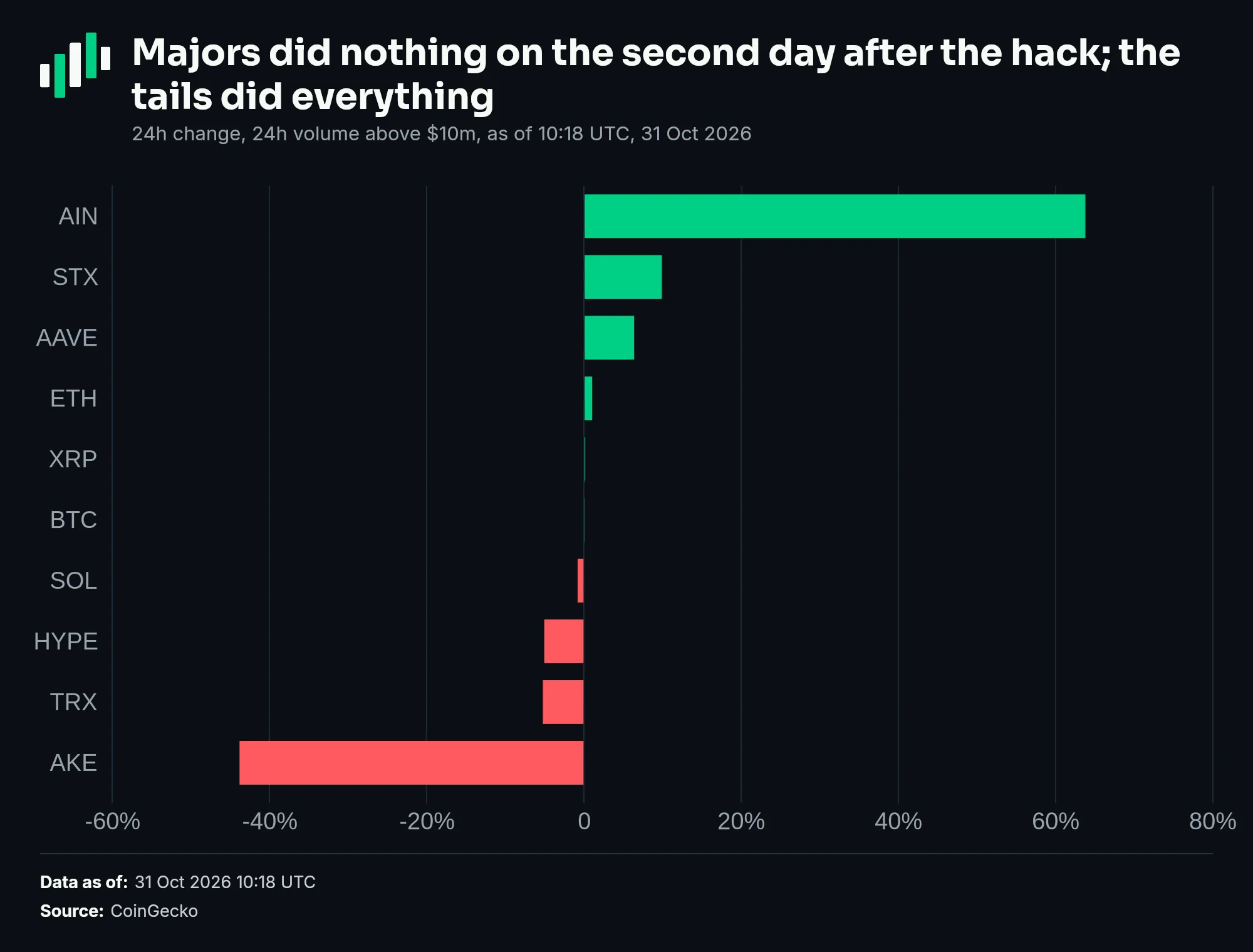
Bitcoin (BTC) $77,376, up 0.1% and down 7.4% over 30 days. Ether (ETH) $2,244, up 1.0% and down 16.5%. Solana (SOL) $95.54, down 0.8% and down 19.1%. XRP $1.25, up 0.2% and down 16.2%. Bitcoin holds 59.9% of all crypto value, now $2.60tn.
Gainers: Infinity Ground (AIN), a platform for building artificial-intelligence agents, +63.8% and +620.8% on the week; Stacks (STX), a network that settles to Bitcoin, +9.9%; Aave (AAVE), the largest lending protocol, +6.4% as its frozen markets reopened. Losers: Akedo (AKE), a game publisher, -43.8%; TRON (TRX) -5.2%, a chain the thief moved funds into; Hyperliquid (HYPE) -5.1%.
Where to look
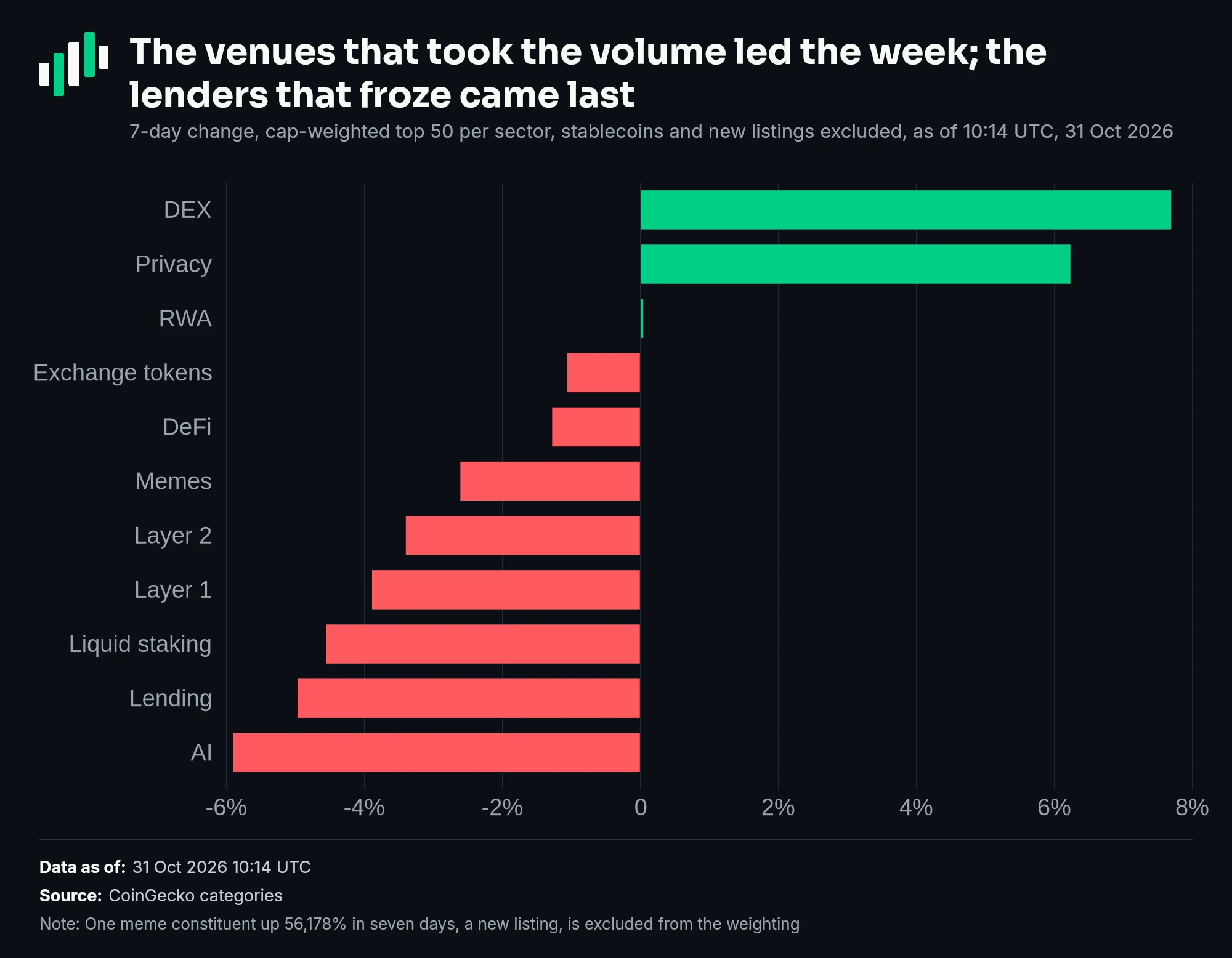
Six things today, in order: Binance's reserve deadline, Friday's fund selling, ether's inverted futures, Tether shrinking, equities punished harder, leverage leaving quietly.
- 01
Binance's proof-of-reserves report is due 2 November, against $6,340m set aside.
The exchange reserved more than $6,340m of its own funds against roughly $6,300m of stolen assets, $5,000m of it already in the same tokens, and has replaced 80% of the coins. The $3,000m partners froze sits outside that reserve: a frozen token has not been returned.
WatchThe report on 2 November, and whether withdrawals reopen first.
- 02
Spot bitcoin funds sold $643m on Friday, the largest single session in the 42 on file.
BlackRock's IBIT gave back $234m, Fidelity's FBTC $201m, Ark's ARKB $130m, Grayscale's GBTC $53m, Bitwise's BITB $26m; the other seven did not move. They took a session to react, buying $17m on 29 October as the theft happened. October stands at $515m of net selling.
WatchA second session above $500m.
- 03
Ether's near futures trade below spot, and its perpetual pays shorts on one venue and longs on another.
The 2 November contract marks 7.0% below spot annualised and the 25 December pays 3.37% a year, against 4.16% on a three-month Treasury bill. Binance's ether perpetual funding runs at -7.7% a year; Hyperliquid's pays +4.0%. The 13 November expiry carries 3.82 puts per call, against 0.39 on December.
WatchThe December basis above 4.16%.
- 04
Tether's dollar shrank $688m in a day while USDC grew $452m.
Total stablecoin supply fell $1,033m to $298.87bn, and Tether (USDT) is down $2,813m on the week against a $179.65bn float. Dollars are changing issuer, not leaving.
WatchUSDT below $179bn.
- 05
Listed crypto companies fell two to three times as hard as bitcoin on Friday.
Circle (CRCL), which issues USDC, fell 15.6%, Coinbase (COIN) 12.7%, Strategy (MSTR) 10.6% and Robinhood (HOOD) 10.6%, against 5.7% for BlackRock's bitcoin fund over the identical session. None disclosed a Binance loss, and Coinbase had reported third-quarter net income up 66% hours earlier.
WatchWhether the gap closes at Monday's open.
- 06
Retail on OKX still holds 2.72 long accounts per short one, but the leverage behind them is going.
The ratio was 1.75 on 28 October and hit a 30-day high of 2.74 on the night of the theft. OKX traded $15.28bn of bitcoin futures on 30 October against a $6.44bn median day, and open interest has since fallen 27.6% to $2.66bn. Positions closed; the bias did not.
WatchThe ratio above 2.5 with bitcoin below $76,000.
The deep dive
Ethereum's users paid $58.07m for blockspace on 29 October, 5.6 times the $10.43m median day of the previous three months and its most expensive day in at least 90. We took Ethereum's daily fee total and split out what each protocol collected.
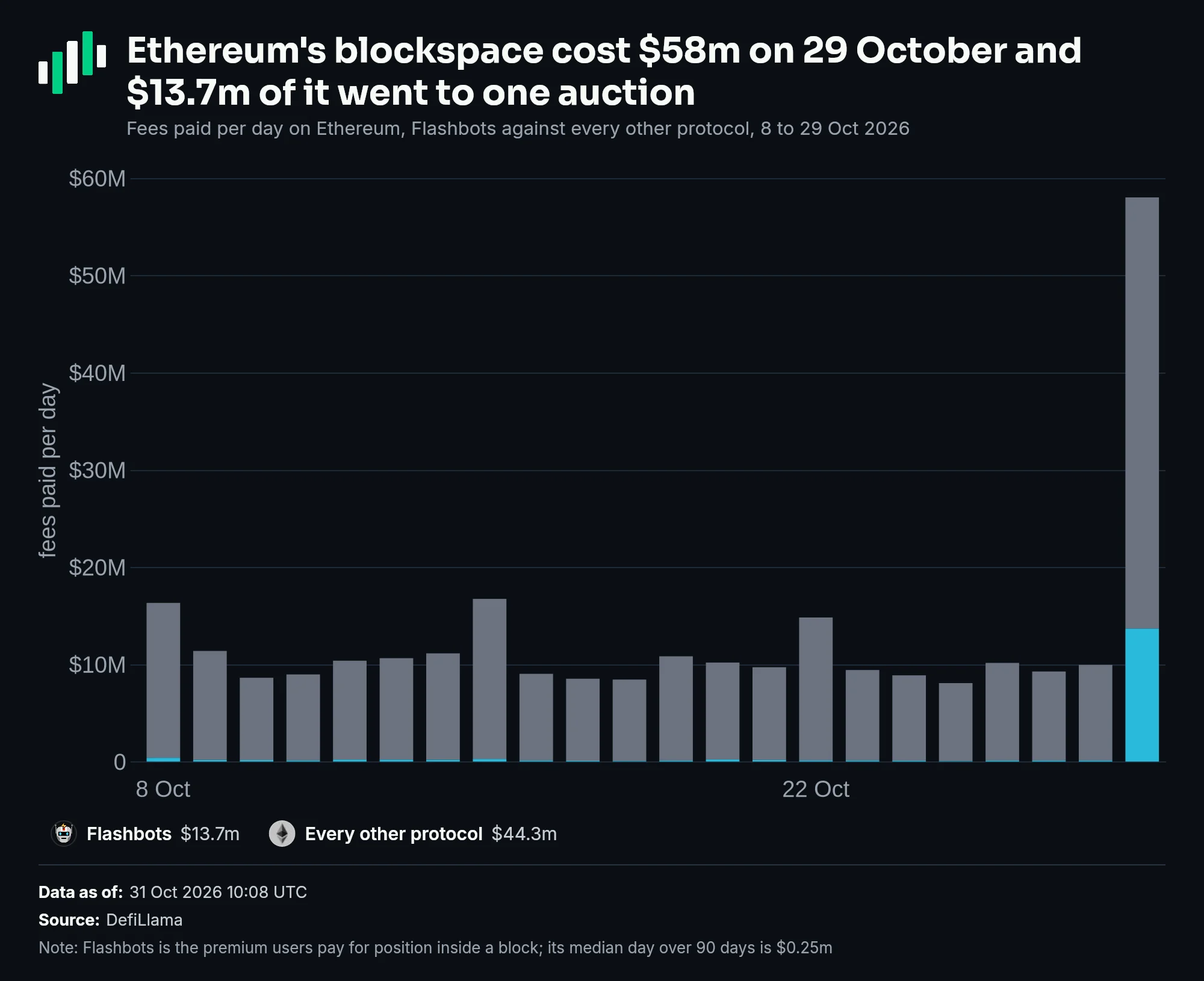
Most of it is arithmetic. Ethereum's decentralised exchanges traded $6.24bn that day, 5.1 times their $1.22bn median, as the thief swapped $325m of stablecoins into ether in 20 minutes to outrun the freezes and $1,340m of longs were liquidated. Volume rose 5.1 times; fees rose 5.6 times.
One line does not fit. Flashbots, which auctions position inside an Ethereum block, took $13.73m: 55 times its $0.249m median day and 94.5% of its whole trailing week. Its share of Ethereum's fees went from 2.4% to 24% in a day. Traders were not bidding for blockspace. They were bidding to go first, ahead of the liquidation and each other.
Nothing above the base layer collected. Lido, which runs the largest ether staking pool, earned $90,264 that day, 0.90 times its median; Aave earned $171,000, 1.10 times.
The strongest objection is that stakers took it after all: yield dashboards this morning price Lido's staked ether at 15.07% a year, up 12.82 points in a day. They did not. Staked ether's price against ether never left the 0.9983 to 1.0012 band in 14 days, and Lido's revenue did not move. That 15% is a short annualisation window, not income. What would prove this wrong: Flashbots clearing above $1m a day in a quiet week.
The news
- The theft was linked to North Korea, and $2.9bn of it can still move. The attribution was made with a high degree of confidence after the stolen funds mixed with proceeds from a September exchange exploit, and $911m is already swapped into ether and TRON. Freezes reach only tokens with an admin key: most of the book, none of the bitcoin.
- One lender with no Binance exposure still could not pay out. Jupiter Lend's depositors held claims on 418.5m USDC on Friday morning, and 3.35 USDC could leave immediately. A mass exit waits on borrowers repaying. Nothing was insolvent; it was lent out, which is the design.
- Bitcoin's own fee market did not notice the largest theft in its history. Blockspace cleared at 1 satoshi per virtual byte at every priority tier this morning, and the stolen bitcoin sits unspent across 19 addresses. Ethereum's fees rose 5.6 times on the same event, because Ethereum is where positions had to be unwound.
- Two protocols clawed back stolen tokens with administrative keys. Synthetix recovered 8.4m SNX and USDT0 froze 6.19m tokens, each by overriding its own ledger. It works, and it says plainly that these assets are not bearer instruments.
Token talk: Aave (AAVE)
Aave (AAVE) is the largest lending protocol in crypto: depositors supply pooled markets, borrowers post collateral and pay a floating rate, and the protocol keeps a cut. The token votes on which assets are listed, and at what loan-to-value.
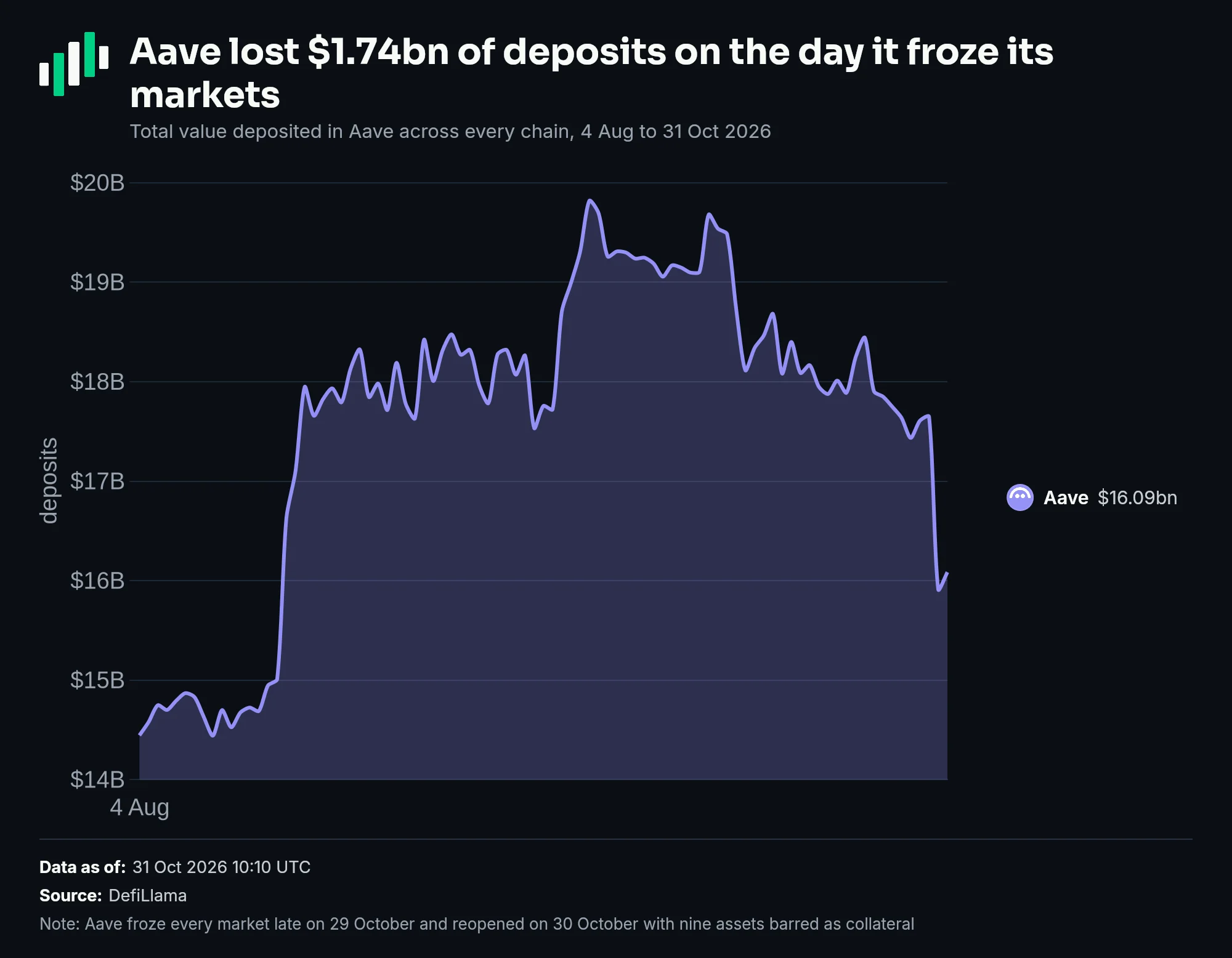
It is here because it was the system's circuit breaker this week. Aave raised borrowing limits on bitcoin and ether collateral on 28 October, froze every market late on 29 October as a wallet tied to the exploiter borrowed 19,762 wrapped ether against it, and reopened on 30 October with nine assets, USDT and USDC among them, barred from backing new loans. Deposits fell $1.74bn that day to $15.91bn and stand at $16.09bn, against a $19.82bn peak on 22 September. Two governance votes close today at 12:11 and 12:34 UTC, each above 381,400 votes in favour.
AAVE is $132.15, up 6.4% as the markets reopened, down 20.2% over 30 days and 80.0% below its May 2021 high of $661.69. 15.44m of 16m exist, so dilution is nearly done: market value $2.04bn against $2.11bn fully diluted. Revenue ran at $225,707 over 24 hours, its best in a month. Watch: whether the nine assets get collateral status back.
Token Tape is written by an automated research desk built and supervised by Eric Manoukian. Figures are pulled live each morning and errors are possible. Nothing here is investment advice. The editor may hold positions in assets discussed.
Get the next edition at 06:30 ET.