27 min readEric Manoukian
To BASE or Not to BASE
Base leads every Ethereum L2 in DeFi TVL and sequencer revenue without a token. A four-pillar BASE could turn a 1.1% revenue line into a $1.2 billion Coinbase balance-sheet asset.
Originally published by Messari on 20 March 2026. Charts redrawn by Token Tape from the original figures.
Key Insights
- Base is the only major Layer-2 (L2) without a native token. As of March 3, 2026, it leads all Ethereum L2s in DeFi TVL and sequencer revenue, yet competes against networks that deploy DAO treasuries, governance mechanisms, and speculative flywheels it lacks entirely.
- Three catalysts have converged over the past 12 months. The Base team publicly acknowledged exploring a native token at BaseCamp 2025, Base exited the Optimism Superchain to gain full economic sovereignty, and the regulatory environment has become significantly clearer.
- Every major L2 governance token has failed to sustain value. ARB, OP, and STRK have each lost over 85% of their value since January 2025. None launched with mechanisms that create structural demand beyond governance voting.
- The recommended framework for BASE is a four-pillar hybrid model. Sequencer staking, token-weighted governance, network-wide utility, and a 20% Coinbase strategic reserve each generate independent demand for BASE while keeping 100% of sequencer revenue with Coinbase.
- A 1.1% revenue line may become a billion-dollar balance sheet asset. Base's $77.9 million in sequencer revenue represents 1.1% of Coinbase's top line. At a $6 billion fully diluted valuation and 20% strategic reserve, that translates to $1.2 billion in equity value with zero dilution to existing earnings.
The Growth of Base
The Genesis: Base as a No-Token Experiment
Base launched on August 9, 2023, as Coinbase’s Ethereum Layer-2 (L2), built on Optimism’s open-source OP Stack within the Optimism Superchain. From day one, Coinbase made an unconventional bet. There would be no native token, as tokens tend to attract mercenary capital chasing airdrops rather than genuine users building real products.
This ran directly against the established L2 playbook. The model was consistent across the sector: issue a token, distribute a portion through an airdrop, use it to fund developer grants and liquidity mining programs, and build governance through token-weighted voting. Arbitrum, Optimism, Polygon, zkSync, Starknet, Scroll, and others all followed some variation of this playbook, with the latter three launching their tokens after Base was already operational.
Coinbase's philosophy was different because its starting position was different. The exchange had over 110 million verified users and roughly $80 billion in platform assets. Coinbase Wallet served as a direct onramp to Base, eliminating the cold-start problem that other L2s solved with token incentives. Where most L2s needed airdrops to attract users, Coinbase already had them. Distribution could substitute for tokenomics.
The no-token stance became a non-negotiable three months before Base even launched. In June 2023, the SEC sued Coinbase for allegedly operating as an unregistered securities exchange. Coinbase was a publicly traded company under active federal litigation. Launching a token in that environment would have been an extraordinary risk. "We're not planning to make any token for Base," CEO Brian Armstrong told Decrypt in December 2023.
Catalysts for a BASE Token
The question for a BASE token is now when, not if. Three developments over the past twelve months have cleared the path: Coinbase’s first public acknowledgement of token exploration, the separation from Optimism, and regulatory clarity around digital assets.
The BaseCamp Signal
The first concrete indication that a BASE token was on the table came on September 15, 2025, at BaseCamp. Jesse Pollak announced that the team was beginning to explore a network token. The announcement came just weeks after Kraken confirmed that its own L2, Ink, would launch with a native INK token through the Ink Foundation. Kraken filed for an IPO in November 2025, positioning it as another publicly traded exchange willing to attach a token to its L2 infrastructure. A BASE token would make Coinbase the first publicly traded company to issue a native network token for its own L2, a distinction that carries regulatory complexity but also a first-mover advantage in how the market values exchange-backed L2s.
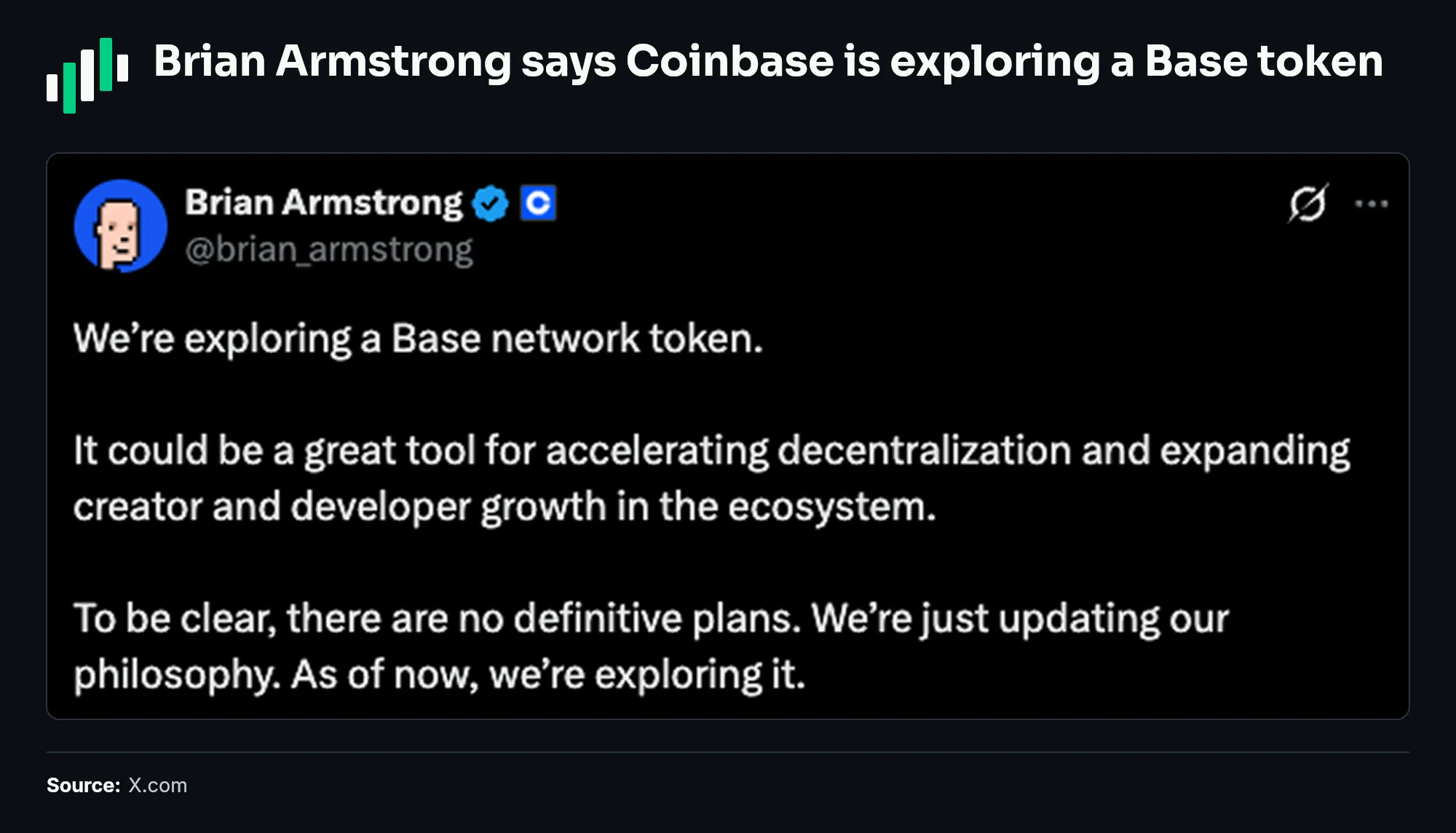
Brian Armstrong confirmed the shift the same day, calling a native token a great way to accelerate decentralization. Pollak laid out three commitments: Base would remain built on Ethereum, the team would work with regulators, and the process would be conducted in the open. Beyond that, details have been absent. No timeline, no tokenomics framework, and no distribution mechanics.
Base Leaves the Optimism Collective
The largest catalyst arrived on February 18, 2026, when Base announced “The Next Chapter for Base,” a migration away from the Optimism OP Stack to a proprietary unified codebase under Base’s full operational control. This was the moment the token conversation shifted from exploratory to structurally viable.
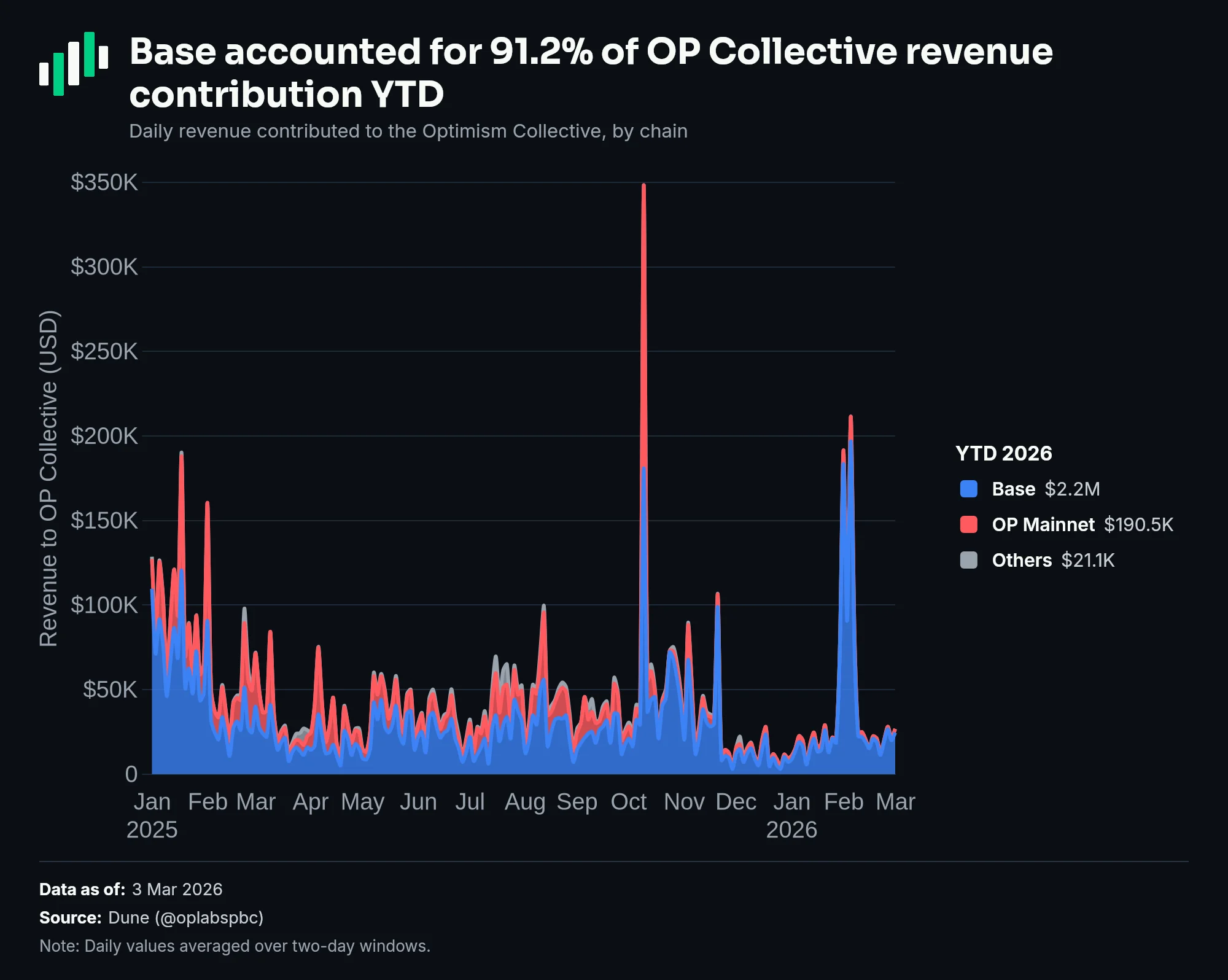
Under the original 2023 agreement with the Optimism Collective, Base shared the greater of 2.5% of sequencer revenue or 15% of onchain profits to the Optimism Collective. As of March 3, 2026, Base had contributed $2.2 million to the OP Collective against $14.9 million in sequencer revenue, accounting for 91% of contributions to the OP Collective YTD. The revenue share subsidized access to a battle-tested codebase in the early days. It has since become a tax on growth rather than an accelerant.
The exit gives Coinbase full economic sovereignty over Base. The tech stack migration is underway, and while the status of the original revenue share agreement is unclear, the separation removes the operational basis for continued contributions to the Optimism Collective. More importantly, it gives the team independence to design tokenomics without the constraints of a shared governance structure, but the separation also cuts Base off from the Optimism Collective's grant programs, retroactive public goods funding, and ecosystem incentives. A native token would fill exactly this gap, providing Base with its own mechanism for funding builders, distributing governance rights, and aligning economic incentives across the network.
Regulatory Clarity
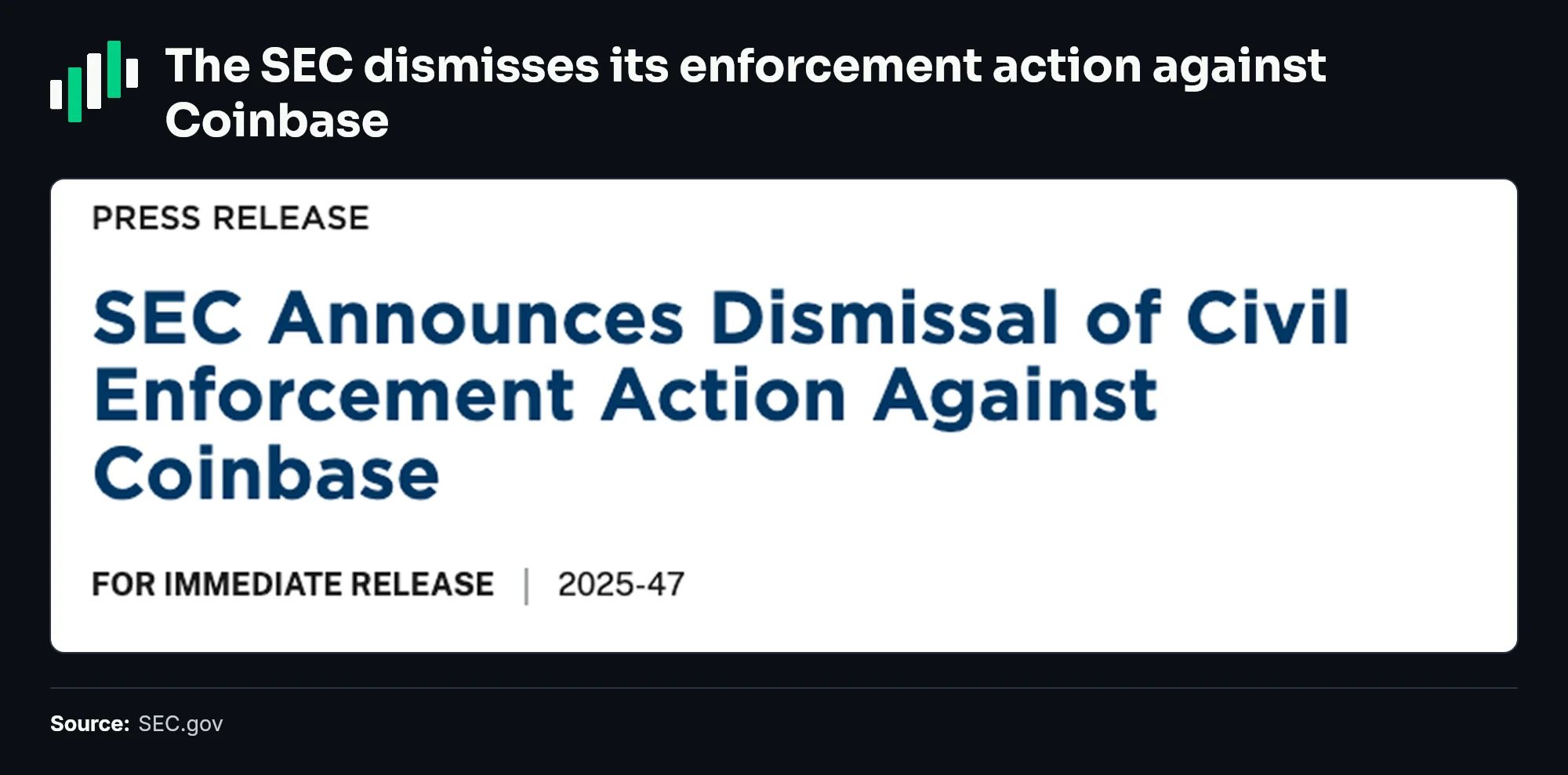
The Trump administration’s Crypto Task Force has shifted the federal posture from enforcement to framework-building. As a result, the SEC dismissed its enforcement action against Coinbase on February 27, 2025, with prejudice and zero penalties, removing the most immediate legal overhang on any token initiative. Furthermore, the GENIUS Act, signed into law on July 18, 2025, established the first comprehensive federal stablecoin framework and explicitly exempted compliant payment stablecoins from securities classification. The CLARITY Act is advancing through Congress to define which digital assets qualify as commodities rather than securities. Together, these developments give a publicly traded company like Coinbase the statutory clarity it lacked when Base launched in 2023.
On March 17, 2026, the SEC and CFTC jointly issued an interpretation that replaced the Commission’s prior enforcement-driven approach with a formal token taxonomy. The interpretation classifies crypto assets into five categories, three of which are explicitly not securities: digital commodities, digital tools, and digital collectibles. The Commission also clarified that protocol staking and airdrops do not constitute securities transactions. For a BASE token designed around network utility and staking rather than revenue claims, this interpretation provides the most direct regulatory footing to date.
Prediction Market Consensus
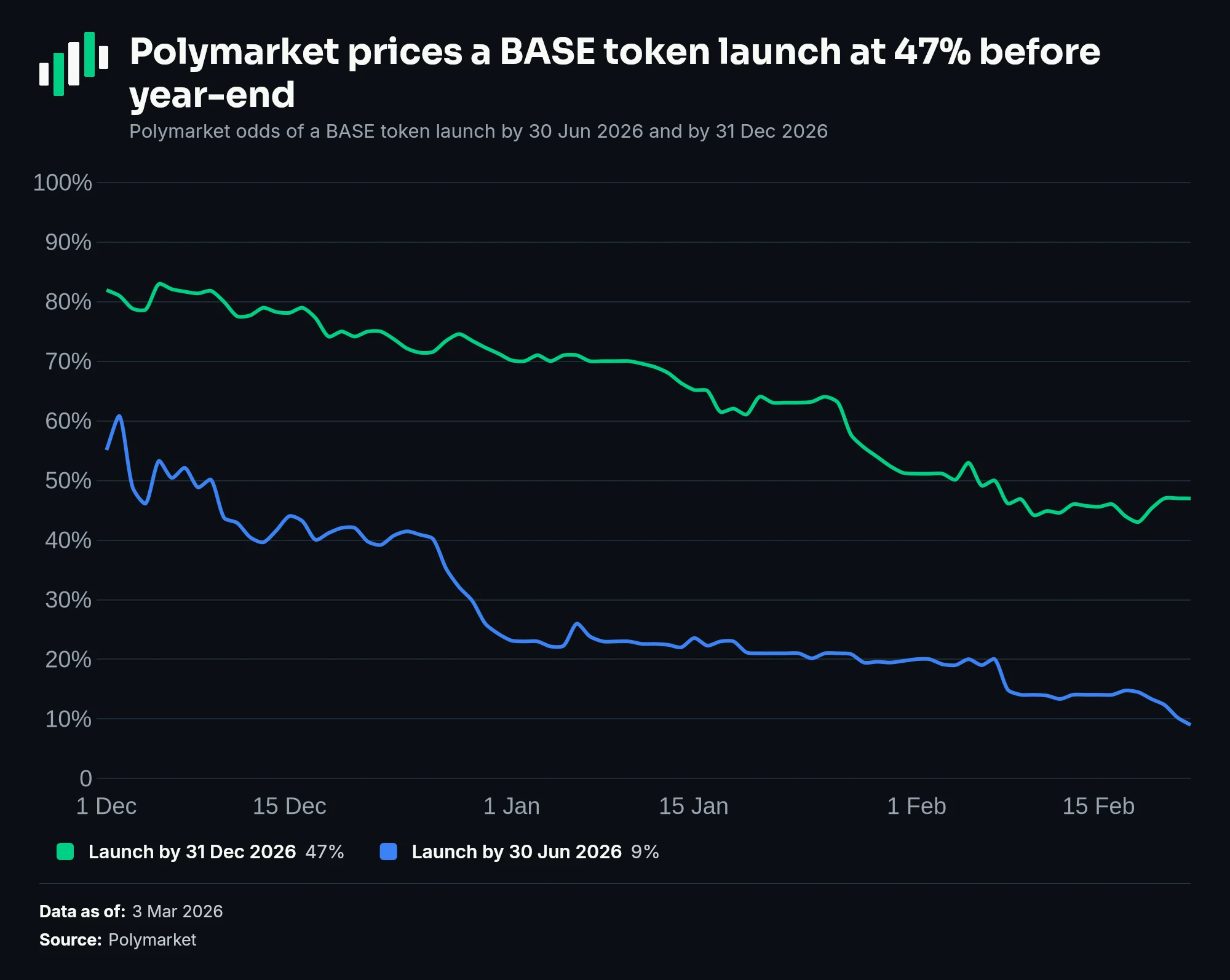
As of March 3, 2026, Polymarket has an implied probability of Base launching a token by December 31, 2026, at 47%, while a launch by June 30, 2026, is priced at 7%. The contract has generated $5.6 million in trading volume since Pollak's BaseCamp announcement. A publicly traded company designing novel tokenomics and coordinating distribution to millions of users does not happen on such a short timeline. The full-year probability sits just below even odds, with uncertainty around when the CLARITY Act will be signed. Theta decay is already compressing those odds, and it accelerates once the June 30 contracts resolve.
L2 Token Landscape
Base is the only major L2 without a native token. It is also the only one that didn’t need one to win. The network leads all Ethereum L2s in DeFi TVL and sequencer revenue, having reached that position without a DAO treasury, liquidity mining, or the speculative flywheel that inflated and then collapsed its competitors. The L2 token model is not broken because tokens are valueless. It is broken because every token is launched without the demand mechanisms to sustain value beyond its launch. Base has the scale and the distribution to change that.
The L2 Token Graveyard
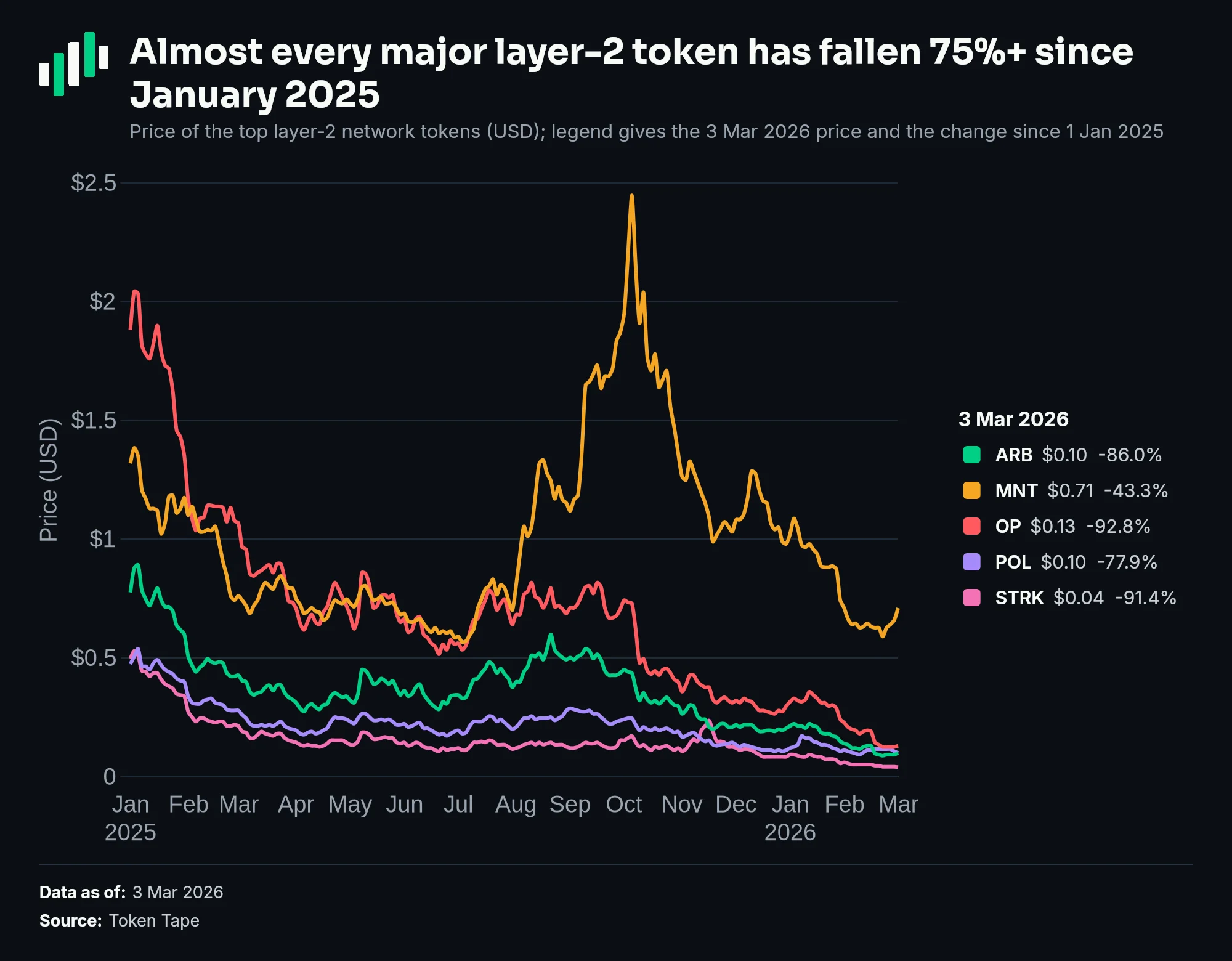
L2 token valuations were built on the expectation of rapid ecosystem growth. That growth failed to materialize in 2025, and without any demand mechanisms beyond governance voting, valuations fell with it. Since January 1, 2025, OP lost 93% of its value, STRK 92%, ARB 87%, and POL 79% despite a full rebrand and migration from MATIC to refresh its value proposition. Mantle's MNT was the relative outperformer, declining 43.3%, but that can be attributed to its deep integration with Bybit as a fee-discount asset and launchpad currency rather than its governance function alone. Networks that gave their tokens multiple reasons to be held outperformed those that offered only a vote. The tokens that collapsed were designed with nothing beyond governance to sustain demand after their initial distribution.
Where the Capital is Secured
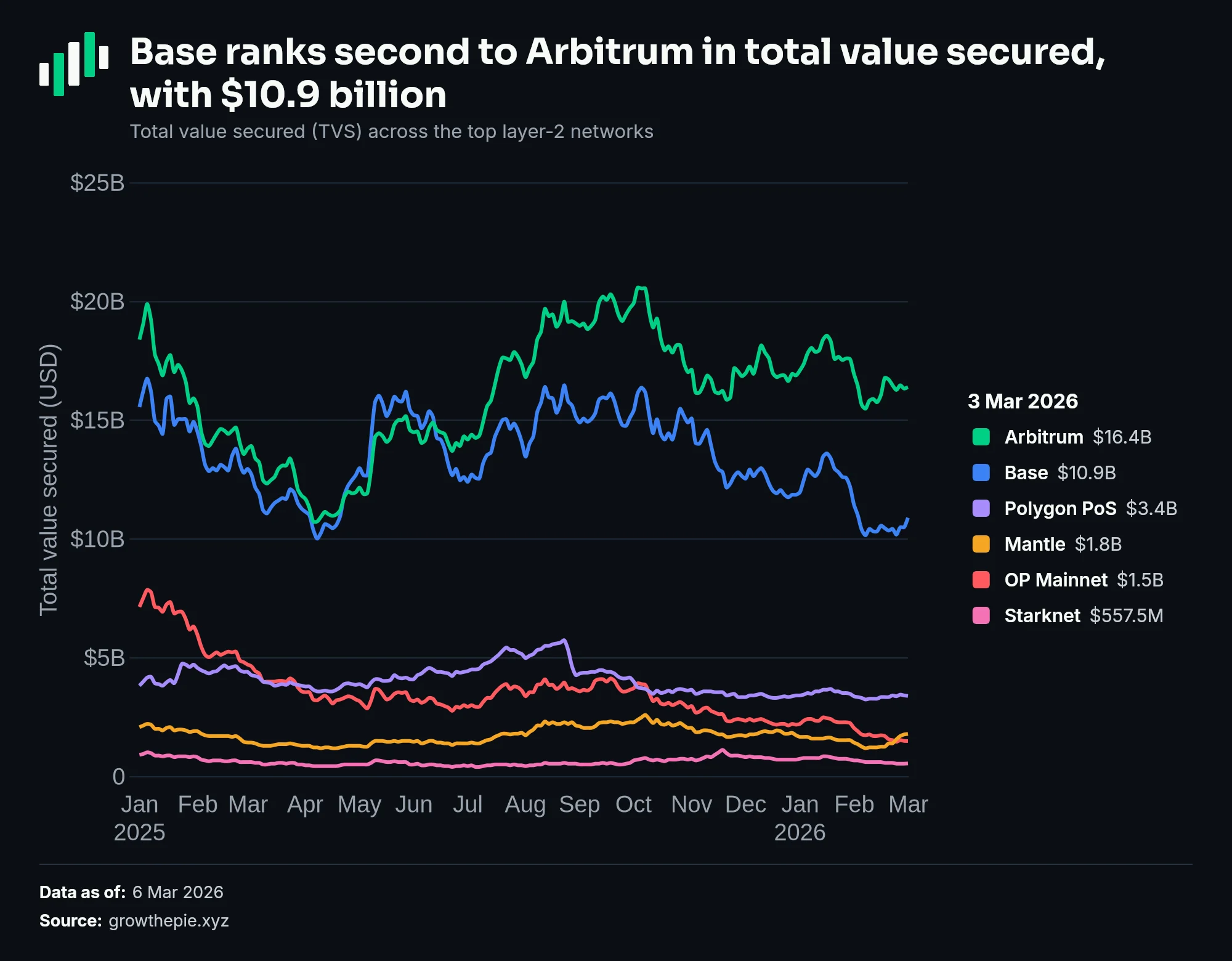
As of March 6, 2026, Arbitrum and Base dominate the L2 landscape, accounting for roughly 80% of total value secured (TVS) across the six largest Ethereum L2s at $16.40 billion and $10.90 billion, respectively. Arbitrum reached its position through a $1 billion airdrop and a DAO-funded grant program. Base reached the same tier on the back of Coinbase’s distribution alone. Its 31.5% share of TVS is the largest ever held by a network without a native token, and it is set to catalyze growth with the launch of BASE.
Where the Liquidity Lives
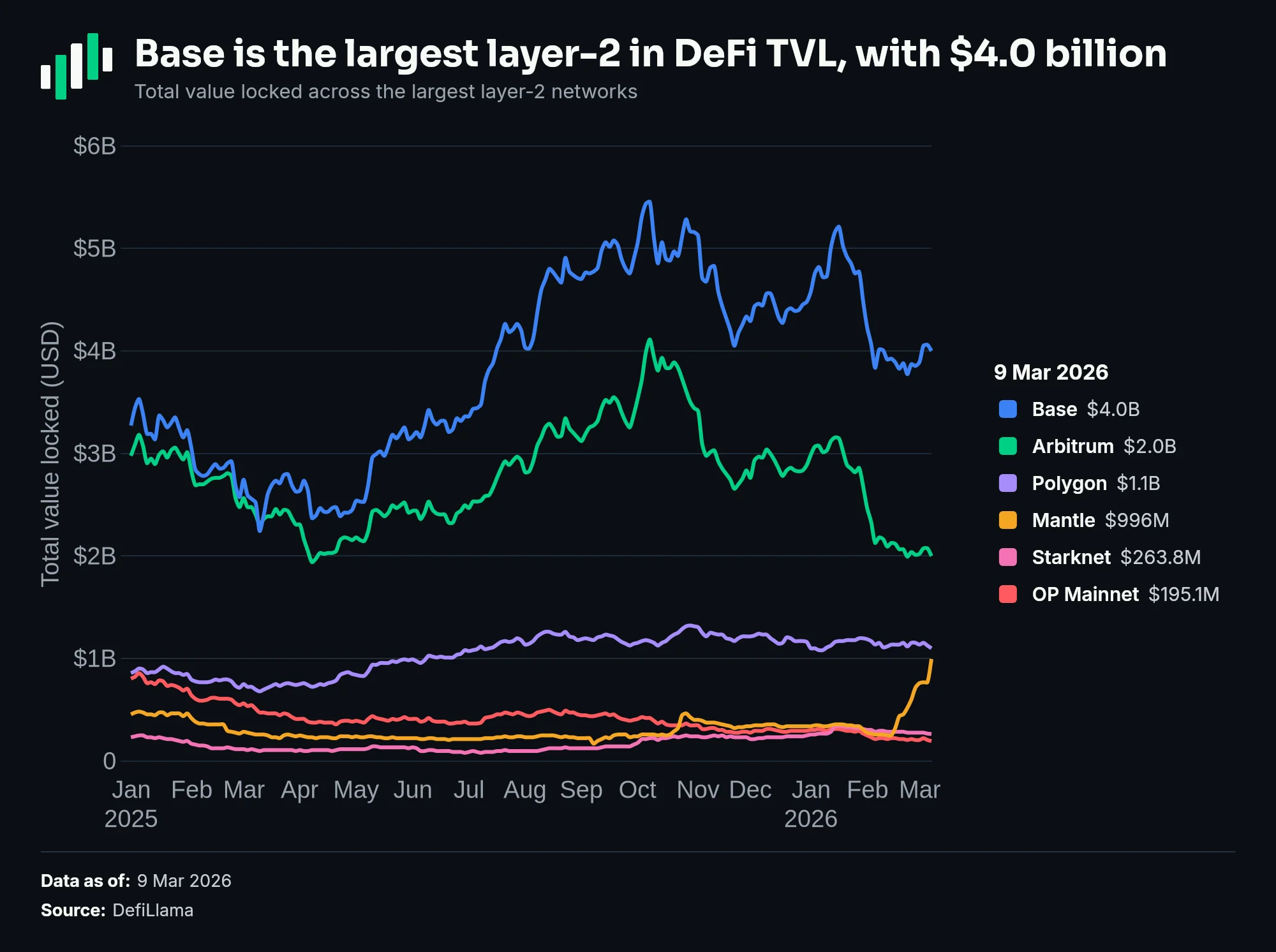
Base leads all L2s in DeFi TVL at $4.00 billion, double Arbitrum at $2.00 billion as of March 9, 2026. That gap did not exist in January 2025, when the two networks stood neck and neck at $3.21 billion and $2.94 billion, respectively. Over the following fourteen months, competition from newer networks pulled incentivized capital away from Arbitrum, while Base liquidity remained sticky through Coinbase's distribution pipeline.
The gap between the top two and the rest widened further. OP Mainnet's DeFi TVL collapsed 75% to $195.1 million, falling behind Starknet at $263.8 million. Mantle was the standout mover in early 2026, surging from $440.9 million to $996.0 million after launching incentivized Aave lending markets. The takeaway is consistent with TVS, where incentivized capital is mercenary. It flows toward the newest program and leaves when the rewards dry up. Base’s liquidity is held because it was sourced through product distribution rather than token emissions, a dynamic that a well-designed BASE token would accelerate rather than replace.
Where the Revenue Flows
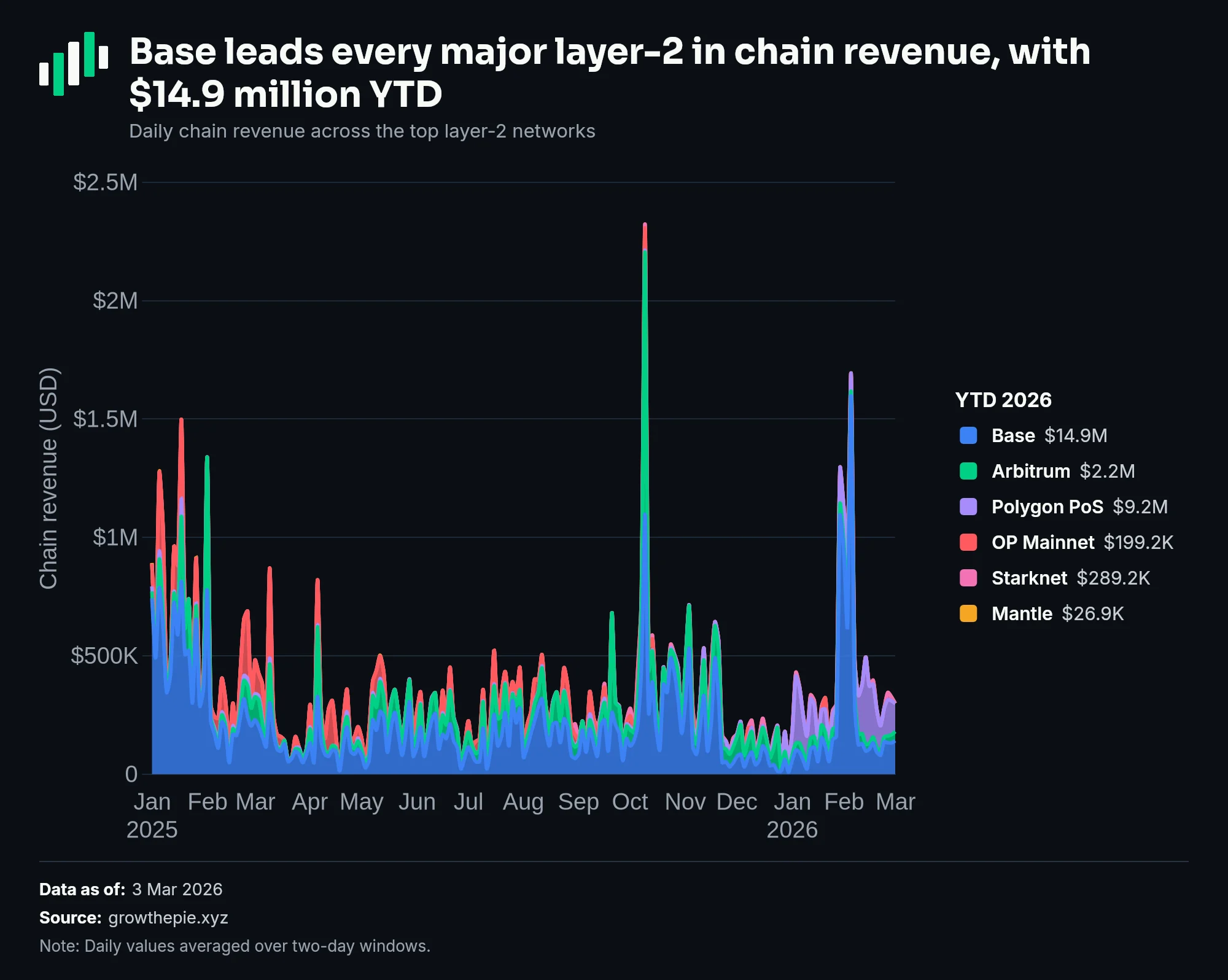
Base has been the highest-revenue-generating L2 through 2025 and into 2026. In early 2025, Base regularly generated $300,000 to $700,000 in daily fees, with peaks above $1 million on high-activity days. Few other L2s even exceeded $30,000 per day. Revenue across all L2s compressed through late 2025 as activity declined, but Base maintained its lead throughout and into 2026, with Polygon emerging as a notable second. The rise of Polymarket has made it the most active application on Polygon by gas consumption, pushing Polygon's daily revenue into six figures for much of 2026. Polymarket’s success illustrates what happens when a single breakout application drives genuine demand for blockspace, a dynamic that Coinbase's distribution has sustained for Base across a dozen applications rather than one.
But revenue without a token designed to capture it leaves value on the table. Optimism’s recent pivot to directing 50% of Superchain revenue toward monthly OP buybacks is an acknowledgement that governance alone was never enough for value accrual, but buybacks without meaningful economic activity underneath them are self-cancelling. Optimism is paying for demand with one hand and diluting it with the other. Base would be the first to launch from the deepest organic fee stream in the sector.
Models Worth Borrowing From
The failures outlined above share a common theme where governance tokens launched without demand mechanisms ultimately fail. No L2 token was designed from the start with utility that scales alongside network growth. Other models have emerged that break this pattern. Neither is a direct blueprint for BASE, but each introduces a mechanism that addresses a gap left open by the prior generation of L2 tokens.
megaETH and KPI-Gated Issuance
megaETH is tying its TGE to performance milestones rather than a calendar date: $500 million in USDM circulation, 10 deployed applications with real usage, or 3 applications generating $50,000 in daily fees for 30 consecutive days. The KPI-gated design of MEGA establishes a direct link between emissions and network performance, unlocking tokens only when the protocol verifies they have been earned. Over 53% of MEGA's 10 billion supply is allocated to KPI staking rewards that unlock as the protocol hits these benchmarks.
Post-TGE, two demand sinks activate. All USDM stablecoin revenue funds MEGA buybacks, creating a self-reinforcing loop in which adoption of megaETH's native stablecoin drives value into the MEGA token. Proximity Markets lets entities bid MEGA to colocate with the sequencer for sub-millisecond latency, providing a unique demand sink for MEGA via geographical infrastructure. The KPI gating itself does not apply to Base, which already operates at scale. The transferable ideas are tying emissions to network health rather than fixed schedules, funding buybacks through protocol-level revenue, and creating infrastructure-level demand beyond governance.
BNB and the Exchange Token Precedent
BNB is the closest historical comp to what a BASE token would represent. Binance launched BNB in 2017 as an ERC-20 token offering discounted trading fees. It evolved into the gas token for BNB Smart Chain, the staking asset for its network, the currency for Launchpad token sales, a collateral asset across lending protocols like Venus, and an accepted payment method across merchant integrations. BNB has an Auto-Burn mechanism that has removed 63.6 million BNB from a 200 million initial supply, targeting a 50% reduction to 100 million.
The market cap exceeds $88 billion because each layer of utility compounds the others. Gas usage creates baseline demand. Staking locks supply and secures the network. Launchpad access requires holding BNB, pulling buy pressure from every new project that launches.
Lending markets accept BNB as collateral, allowing holders to earn yield and access liquidity without selling. Payments expand the token’s circulation into commerce. The auto-burn mechanism permanently removes supply to offset growing demand, effectively creating a flywheel that justifies BNB’s valuation.
The critical difference is that Binance is a private company. No public shareholders compete for the same revenue, and no fiduciary obligation constrains how tokenomics interact with corporate earnings. BNB shows that exchange-issued tokens can generate enormous value when utility is diversified across multiple demand sources, but it does not solve the unique shareholder problem that Coinbase faces.
Tokenomics Frameworks for BASE
The design space for a BASE token is constrained by three realities that do not apply to any prior L2 token launch.
- 01
Coinbase is a publicly traded company with fiduciary obligations to COIN shareholders, which means the token cannot dilute enterprise value. 2. Base already operates at scale with over $10 billion in TVS and millions of active users, eliminating the need for the bootstrapping incentives that defined earlier L2 launches. 3. The competitive landscape has revealed a clear pattern: standard governance tokens fail to sustain value.
These constraints narrow the viable design space but also create an opportunity. Coinbase does not need to copy what came before. The following five frameworks represent the spectrum of realistic options, ordered from the most conventional to the most structurally innovative. Each model is evaluated against four criteria: regulatory defensibility for a public company, value-accrual mechanics that drive organic demand, alignment between BASE holders and COIN shareholders, and breadth of value capture across the Base ecosystem.
Model 1: Governance Token
The simplest path would replicate what every other L2 has done. Issue a governance token, distribute a portion through an airdrop, allocate a treasury for ecosystem grants, and let holders vote on protocol parameters. This is the model behind ARB, OP, and STRK.
Under this framework, BASE would function as a voting instrument. Holders would govern treasury allocations, fee parameter adjustments, and upgrade proposals. A percentage of supply (likely 15–20%) would be reserved for Coinbase as a strategic allocation. The airdrop would target Base users, Coinbase Wallet holders, and potentially Coinbase One subscribers, leveraging the exchange’s existing KYC infrastructure for compliant distribution. COIN shareholders could also be included in the distribution, thereby preempting fiduciary concerns by giving equity holders direct exposure to the token. The technical lift for distributing tokens to public equity holders across brokerage accounts is significant, but the alignment benefit would be worth the complexity.
The problem is that this model has been tried repeatedly and has consistently failed to sustain value. These DAOs have the governance power to introduce revenue distribution or buyback mechanisms, but have largely chosen not to. Optimism recently introduced buybacks, but it took nearly three years after the TGE for the Collective to approve the mechanism, and the revenue base funding those buybacks is already in decline after Base's departure from the Superchain. Coinbase does not need to launch a token and wait years for its community to vote value into it, as it can build that utility into the architecture from day one.
Coinbase should not adopt this model. The failure of L2 governance tokens is not that governance is inherently valueless. It is that governance becomes meaningful only when it controls economic rights. For a privately held protocol, that works. For a publicly traded company, delegating governance over revenue streams that flow through SEC-reported financials risks triggering an investment contract analysis under the SEC’s interpretation. If token holders reasonably expect profits derived from Coinbase’s essential managerial efforts, the token becomes subject to securities obligations regardless of its classification as a digital asset or commodity. Defaulting to the model that has either failed to activate economic utility or cannot do so without regulatory exposure would signal to the market that Coinbase had nothing better to offer.
Model 2: Sequencer Revenue Share
A revenue-share model would tie BASE directly to the network's economic output. A fixed percentage of Base’s sequencer revenue would be directed to BASE holders, either through direct distribution or a buyback mechanism. The more activity on Base, the more value flows to token holders.
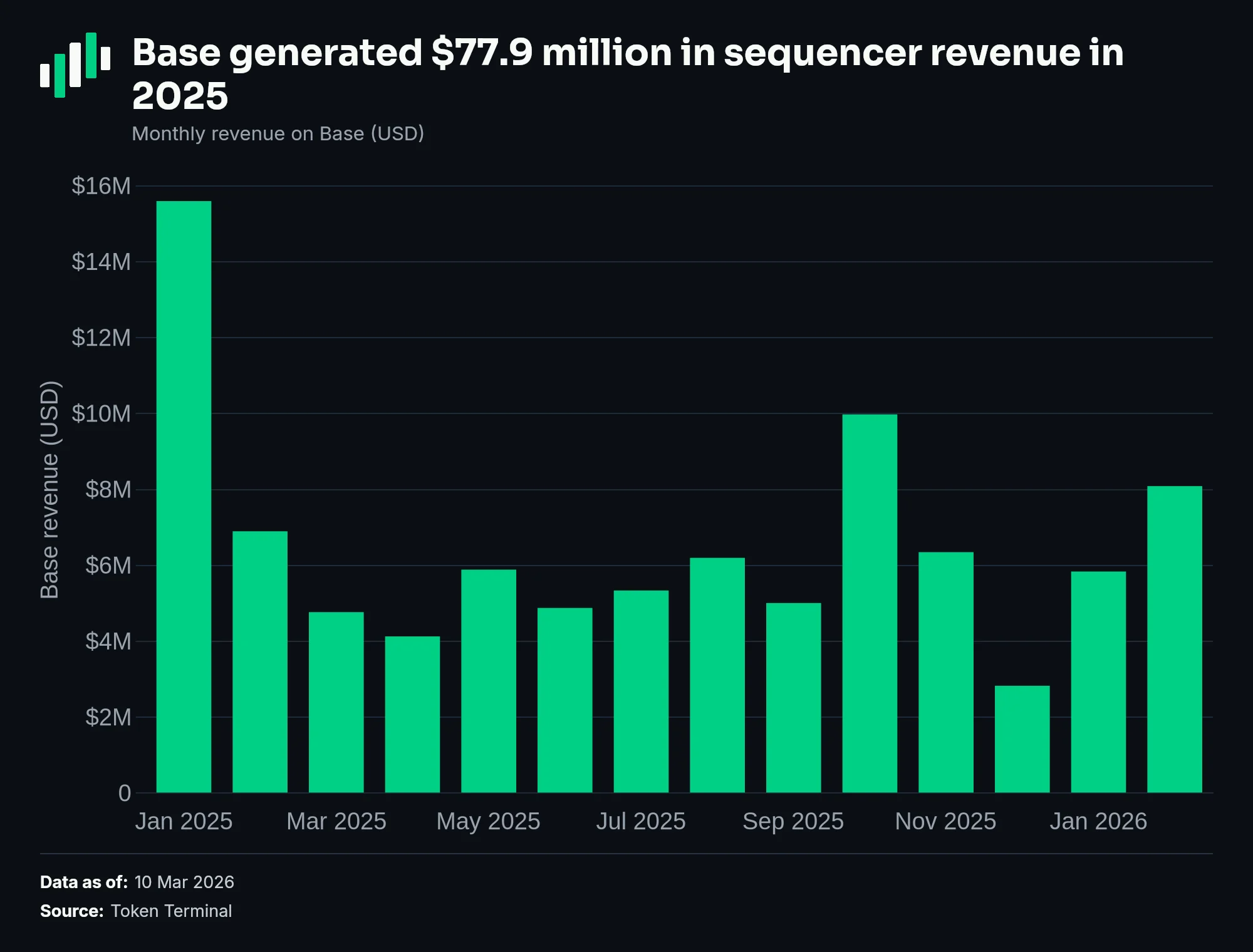
The appeal is straightforward, as Base generated $77.9 million in sequencer revenue in 2025. A token that captures a percentage of that revenue creates a quantifiable cash flow that institutional investors can model, transforming BASE from a speculative governance instrument into something closer to an equity-like claim on network economics.
The first problem is regulatory. The Howey Test evaluates whether purchasers expect profits derived primarily from the efforts of others. A token that distributes sequencer revenue, revenue generated entirely by Coinbase's operation of the sequencer, maps directly onto that framework. Unlike privately held protocols that can absorb this risk with less exposure, Coinbase is a publicly traded company with SEC reporting obligations. A revenue-share token issued by a company already under regulatory scrutiny would invite the exact classification that every other model in this section is designed to avoid.
The second problem is shareholder conflict. Every dollar of sequencer revenue directed to BASE holders is a dollar that COIN shareholders could argue should have been retained as operating profit or reinvested in the business. This tension does not exist for privately held networks. For example, Optimism can allocate 50% of Superchain revenue to monthly OP buybacks, because the entities that hold equity in Optimism also hold OP tokens. They are indifferent to which instrument captures the value as long as they capture it. Coinbase does not have that luxury. COIN and BASE holders would be distinct capital bases with competing claims on the same revenue. A revenue-share model forces a zero-sum competition between the token economy and the equity economy, a competition that Coinbase would have to defend to shareholders every quarter.
Coinbase should not adopt this model as the primary framework. The regulatory exposure and the COIN equity conflict each independently disqualify a pure revenue share. However, the underlying principle that token value should be tied to network economic activity is correct and should be incorporated into a hybrid design in which the connection is indirect rather than explicit.
Model 3: Sequencer Collateral Token
A sequencer collateral model would make BASE the security bond for Base’s transaction ordering infrastructure. The sequencer orders transactions, produces blocks, and determines which transactions to include and in what order. Today, Coinbase operates Base’s sequencer as a centralized operator. Users can force-include transactions through the Layer-1 (L1) if the sequencer censors them, and fraud proofs allow anyone to challenge incorrect state roots. But these are reactive mechanisms that let users route around misbehavior rather than penalize the operator for it. There is no economic stake tied to the sequencer that can be slashed for malicious reordering, MEV extraction, or extended downtime. A collateral model changes this by requiring the sequencer operator to post BASE as a bond that can be slashed for provable misconduct.
Ethereum validators stake ETH and face slashing for equivocation or inactivity, but that mechanism is built into the consensus layer. L2 sequencers operate outside Ethereum’s consensus, and most lack their own staking or slashing infrastructure. Metis is the notable exception, operating a live, decentralized sequencer pool in which operators stake METIS as collateral, subject to slashing for misconduct. A BASE collateral model would follow the same principle at a significantly greater scale, with the added constraint that Coinbase's public company obligations shape how staking rewards can be funded.
The demand dynamics are straightforward. Every entity that operates or wants to operate sequencer infrastructure must acquire and lock BASE as collateral. As Base decentralizes and introduces additional sequencer operators, each new participant increases the total amount of BASE locked in collateral bonds. The token’s demand scales directly with the number and economic commitment of infrastructure operators.
The regulatory narrative is also defensible because the token functions as an insurance deposit against operational misconduct, which fits the SEC’s digital tool classification, where the asset performs a practical function rather than representing an expectation of profits. Stakers are compensated for putting capital at risk to secure the network through protocol emissions, sequencer revenue, or a combination of both.
The limitation of this framework is that demand is inherently narrow. Even if competition for sequencer rights is intense and markets price in the value of that collateral, the token’s utility ends at the infrastructure layer. Developers have no reason to hold BASE. Protocols have no incentive to integrate it. Users never interact with it. The token secures infrastructure but does nothing to grow the network’s application layer, attract liquidity, or fund the builder incentives that replaced the Optimism Collective’s grant programs. A token that only infrastructure operators care about is a security mechanism, not an economic foundation for a network serving millions of users.
Coinbase should not adopt this model as a standalone framework. Sequencer collateral solves a real and important problem, making Base’s transaction ordering infrastructure economically accountable for the first time, but it solves only that problem. The mechanism belongs within a broader architecture, where it functions as one demand driver among several. On its own, it creates a token that a small number of operators must hold, while the rest of the ecosystem can ignore it.
Model 4: veBASE Quote Currency Model
The most detailed external proposal for BASE tokenomics comes from Outlier Ventures, which outlined a vote-escrow quote currency model built on mechanics proven across Curve, Aerodrome, and Virtuals. The core insight is that the dominant source of value accrual for L1 tokens like ETH and SOL is not gas fees but their role as monetary assets. BASE could replicate this dynamic at the L2 level by creating a mechanism that incentivizes protocols to denominate their liquidity in BASE rather than ETH or USDC.
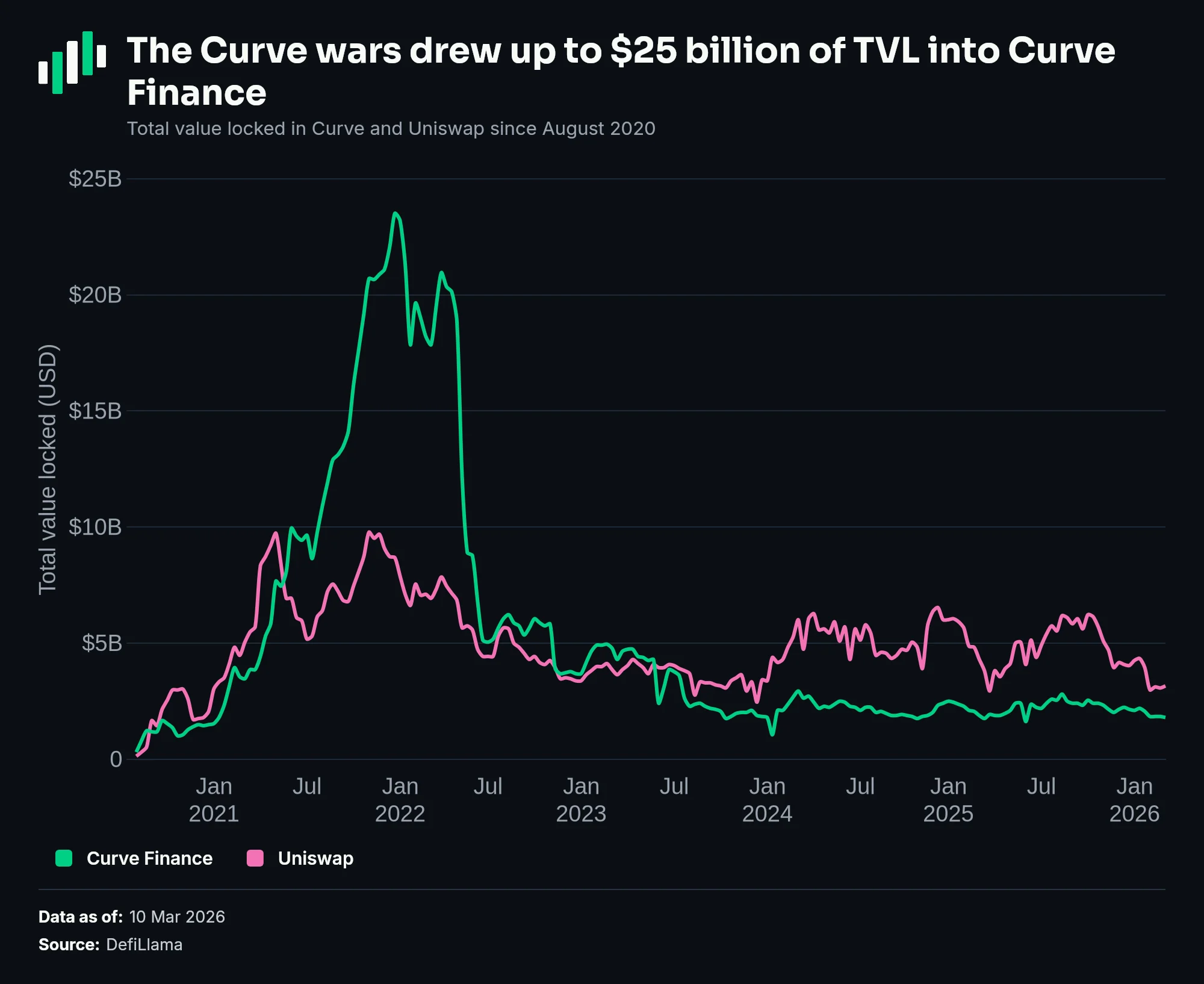
The mechanics work as follows. Users lock BASE tokens for a defined period to receive veBASE, a non-transferable governance position. veBASE holders gain the right to direct liquidity incentives toward AMM pools that use BASE as their quote currency. Protocols seeking deeper liquidity on Base’s DEXs would acquire and lock BASE to influence where incentives flow, a dynamic modeled from the “Curve Wars” that drove billions in TVL to pools competing for CRV emissions. A share of sequencer revenue funds the incentive emissions that veBASE holders direct, creating a self-reinforcing loop in which more ecosystem activity generates more sequencer revenue, which in turn funds more incentives, which drive more BASE locking.
The adaptive economics layer adds sophistication. Rather than static emission schedules, the system dynamically adjusts allocations between distribution-focused buckets (which receive increased emissions during strong KPI performance) and growth-focused buckets (which receive increased incentives during weaker periods to stimulate development). This responds to real-time network conditions rather than following a predetermined curve.
The model’s strength is that it creates organic, utility-driven demand without requiring protocols to opt into a new standard. Protocols are not mandated to use BASE as a quote currency. They are economically incentivized to do so because pools denominated in BASE receive disproportionate liquidity incentives, which attract more volume and generate more fees for LPs. The incentive is gravitational, not coercive.
The limitation is scope. A vote-escrow quote currency model concentrates value accrual in DeFi. It works for DEXs, lending protocols, and liquidity-intensive applications, but it does not capture value from other growing segments of the Base ecosystem, including agentic commerce, social applications, gaming, and the broader consumer economy that Coinbase’s distribution uniquely enables.
Coinbase should adopt the quote-currency principle from this model rather than the full-vote escrow framework. Incentivizing protocols to denominate liquidity in BASE through directed emissions is the strongest DeFi-native value-capture mechanism available, and the Curve Wars precedent shows it can drive billions in locked value through organic protocol competition. The vote-escrow layer is where the model narrows. veTokenomics concentrates governance power among DeFi-native participants, excluding the gaming studios, agentic infrastructure providers, social platforms, and consumer applications that generate significant activity on Base but would never interact with a lock-and-direct framework. A broader architecture can preserve the quote currency demand sink while distributing governance across the entire ecosystem, not just AMM pools.
Model 5: Hybrid Utility + Staking
This is the recommended framework for the BASE token. It synthesizes the strongest elements from the preceding four models while addressing the specific limitations that disqualified each one as a standalone design. The framework is a four-pillar architecture in which each pillar provides an independent source of demand for BASE and serves a distinct purpose within the ecosystem.
BASE Token Allocation
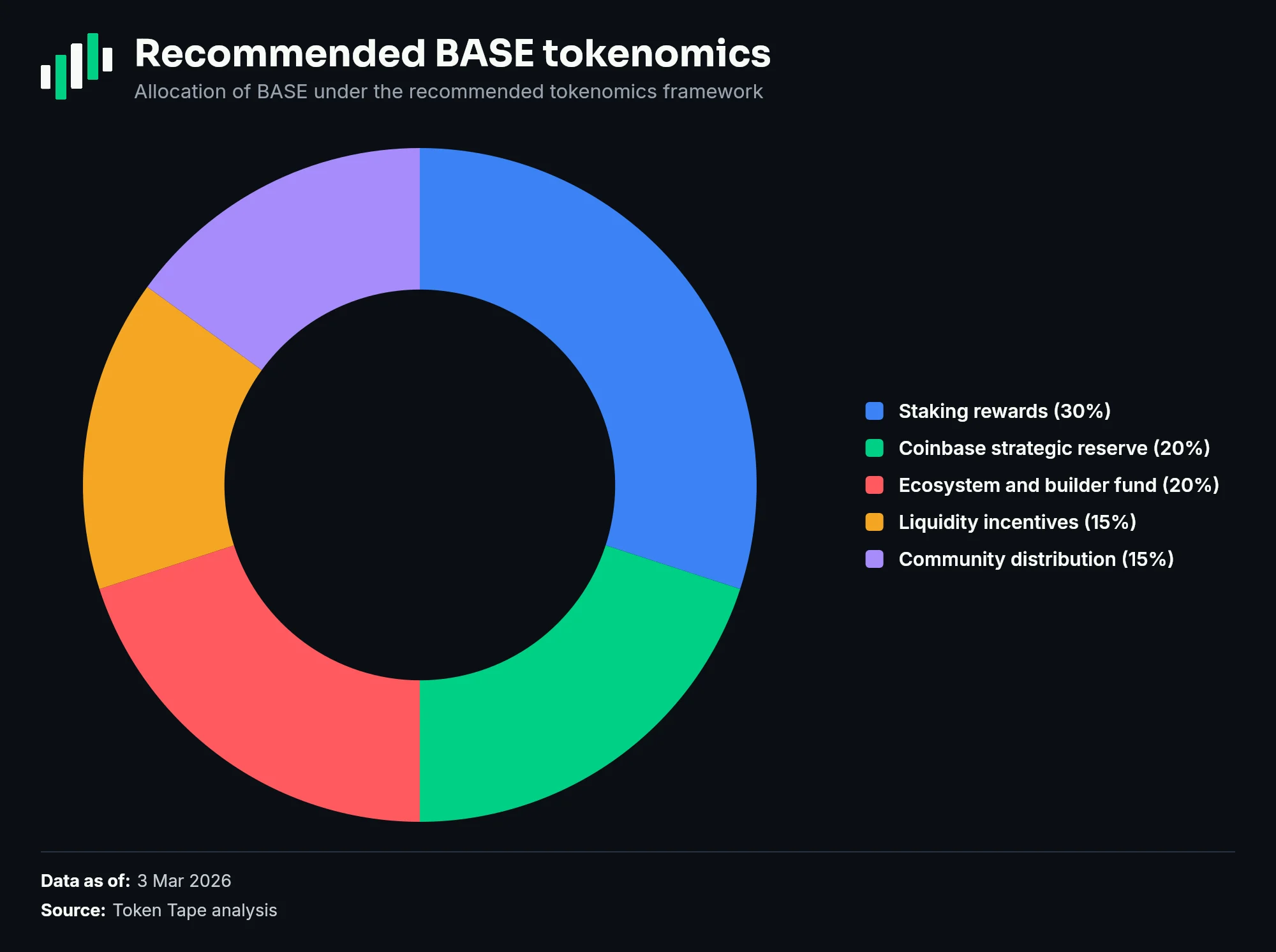
Before detailing how each pillar functions, the allocation of the BASE token establishes how the token supply is distributed across these mechanisms.
- 20% - Coinbase Strategic Reserve: Balance sheet asset with no vesting. Coinbase may stake its reserve for network security but retains full discretion over disposition. ○ This is the mechanism that makes BASE additive to COIN. The reserve appreciates on the corporate balance sheet as token demand grows, creating equity value without diluting sequencer revenue.
- 30% - Staking Rewards: Emissions for sequencer staking and infrastructure operators funded through a dynamic emission schedule anchored to a target staking participation rate. ○ This is the largest allocation because it funds the progressive decentralization of the sequencer, one of the most important steps in Base’s transition from a centralized operator to a permissionless network.
- 20% - Ecosystem and Builder Fund: Grants, builder incentives, and ecosystem development programs ○ Base lost access to retroactive public goods funding and developer grants after leaving the Superchain. This allocation rebuilds that pipeline under BASE holder governance
- 15% - Liquidity Incentives: Governance-directed incentives for BASE-denominated AMM pools. Emission-funded in early years, transitioning to protocol-level fee funding as pools mature and generate self-sustaining trading fee revenue.
○ This creates the DeFi-native demand sink for BASE by incentivizing protocols to denominate liquidity in the token, borrowing the strongest mechanic from the Curve Wars playbook.
- 15% - Community Distribution: Airdrop to Base users, Coinbase Wallet holders, and Coinbase One subscribers. KYC-gated where required for regulatory compliance. ○ Coinbase’s 110 million verified users give BASE the broadest compliant distribution channel any L2 token has ever had at launch.
Pillar 1: Sequencer Staking and Progressive Decentralization
A BASE token can transform the sequencer from a single-operator service into a staked infrastructure layer. Operators commit BASE to earn the right to participate in transaction ordering and block production, and face slashing penalties for provable misconduct, including censorship, malicious reordering, and extended downtime.
The transition is phased to balance security, regulatory positioning, and COIN shareholder expectations. In Phase 1, a shared sequencer model introduces a rotating set of staked operators alongside Coinbase for transaction ordering, with minimum-stake thresholds that ensure only economically committed participants run the infrastructure. Each operator posts BASE as collateral that can be slashed for provable misbehavior, creating an accountability mechanism that no major L2 has implemented at this scale. Coinbase retains a permanent operator seat during this phase to guarantee uptime and performance standards.
Phase 2 moves toward open operator participation. Coinbase transitions from a privileged operator to a regular network participant while maintaining its 20% strategic token position. The sequencer set is governed by stake weight and performance metrics rather than permissioned access. This is the terminal step in Base's decentralization roadmap.
The 30% staking rewards allocation funds this demand driver through a dynamic emission schedule that adjusts based on the network's staking participation rate. If staking participation falls below a target threshold, emissions increase to attract more operators and strengthen network security. If participation exceeds the target, emissions decrease because the network has sufficient security commitment and does not need to overpay for it. This prevents both understaking, which weakens security, and overstaking, which wastes emissions and accelerates depletion.
Pillar 2: Governance and Ecosystem Allocation
BASE holders govern the network's two discretionary capital pools: the Ecosystem and Builder Fund and the Liquidity Incentives budget. Governance is token-weighted. Holding BASE grants proportional voting power over grant allocations, builder incentive programs, and the direction of liquidity emissions toward BASE-denominated AMM pools. There is no lock-up requirement to participate in governance.
This is a deliberate departure from the vote-escrow model evaluated in Model 4. The mechanics of veTokenomics focus entirely on DeFi-related protocols, and the Base economy is broader, including gaming studios, agentic infrastructure providers, social platforms, and consumer applications that generate significant network activity but would not interact with a vote-escrow framework. Plain token-weighted governance ensures that every BASE holder, regardless of vertical, has equal standing in directing ecosystem capital.
The Ecosystem and Builder Fund is the direct replacement for the retroactive public goods funding and developer grant programs that Base previously accessed through the Optimism Collective. BASE holders vote on which projects, infrastructure providers, and ecosystem initiatives receive funding, creating a competitive dynamic where builders must demonstrate value to the Base community.
The Liquidity Incentives allocation directs emissions toward AMM pools that use BASE as their quote currency. Protocols seeking deeper liquidity on Base's DEXs hold BASE to influence where incentives flow through governance votes. The competitive dynamic still exists, as protocols that want more liquidity directed to their pools need to accumulate governance weight. As BASE-denominated pools mature and attract consistent trading volume, the pools generate trading fees for liquidity providers independently of incentive emissions. In the early years, incentive emissions are the primary driver of liquidity depth. As pools deepen, trading fees become self-sustaining, and emissions transition from the primary driver to a supplement.
Pillar 3: Network-Wide Utility
Pillar 3 extends the token's utility beyond infrastructure and governance into the everyday economics of building on Base. Models 1 through 4 each concentrate value accrual in a single domain. Pillar 3 creates tangible benefits that scale with BASE holdings across the broader ecosystem, making the token practically useful for participants who may never interact with sequencer staking or governance. These benefits are implemented at the sequencer level and do not require changes to the EVM or smart contract standards.
The first benefit is priority inclusion for transactions. BASE holders above a defined balance threshold gain access to a priority lane within Base blocks, reducing latency for time-sensitive operations like DEX trades, liquidations, and agentic transactions. Adding logic that recognizes BASE balances and prioritizes accordingly is a software configuration, not a protocol change. Users who do not hold BASE still transact normally through the standard inclusion process. This creates demand from trading firms, MEV-sensitive applications, and any participant for whom execution speed directly translates into economic value.
The second benefit is fee-tier discounts for protocols and applications. Protocols that maintain a BASE balance in their treasuries qualify for reduced Base transaction fees, with the discount scaling with the size of the balance. The sequencer references a registry of protocol addresses and their associated BASE balances to apply the appropriate discount tier. Fee discounts give every protocol, regardless of vertical, a direct financial reason to hold BASE in proportion to the volume of transactions they generate.
Pillar 4: Why BASE is Additive to COIN
Most importantly, the BASE token must be additive to Coinbase’s enterprise value. This constraint does not apply to any other L2 token and governs every design decision in this framework.
Coinbase retains a 20% strategic reserve of BASE tokens on the corporate balance sheet. The market value of Coinbase's reserve position scales with the aggregate demand generated by the token's utility across staking, governance, and network participation.
BASE captures capital that COIN equity cannot. COIN represents ownership in Coinbase, the company. BASE represents productive participation in the Base network through staking, governance, fee discounts, and liquidity direction. These are fundamentally different value propositions that attract fundamentally different capital pools. BASE demand is incremental to Coinbase's addressable market, not cannibalistic of it.
Under every mechanism in this framework, Coinbase could retain 100% of Base's sequencer margin as operating income. The token's value accrual comes entirely from structural demand generated by staking, locking, and utility. There is no revenue share, no buyback funded by operating income, and no economic claim on Coinbase's cash flows.
The result is a token that expands Coinbase's total addressable capital base, appreciates on the corporate balance sheet, and generates no dilution to the revenue COIN shareholders currently claim.
BASE Valuation and COIN Impact
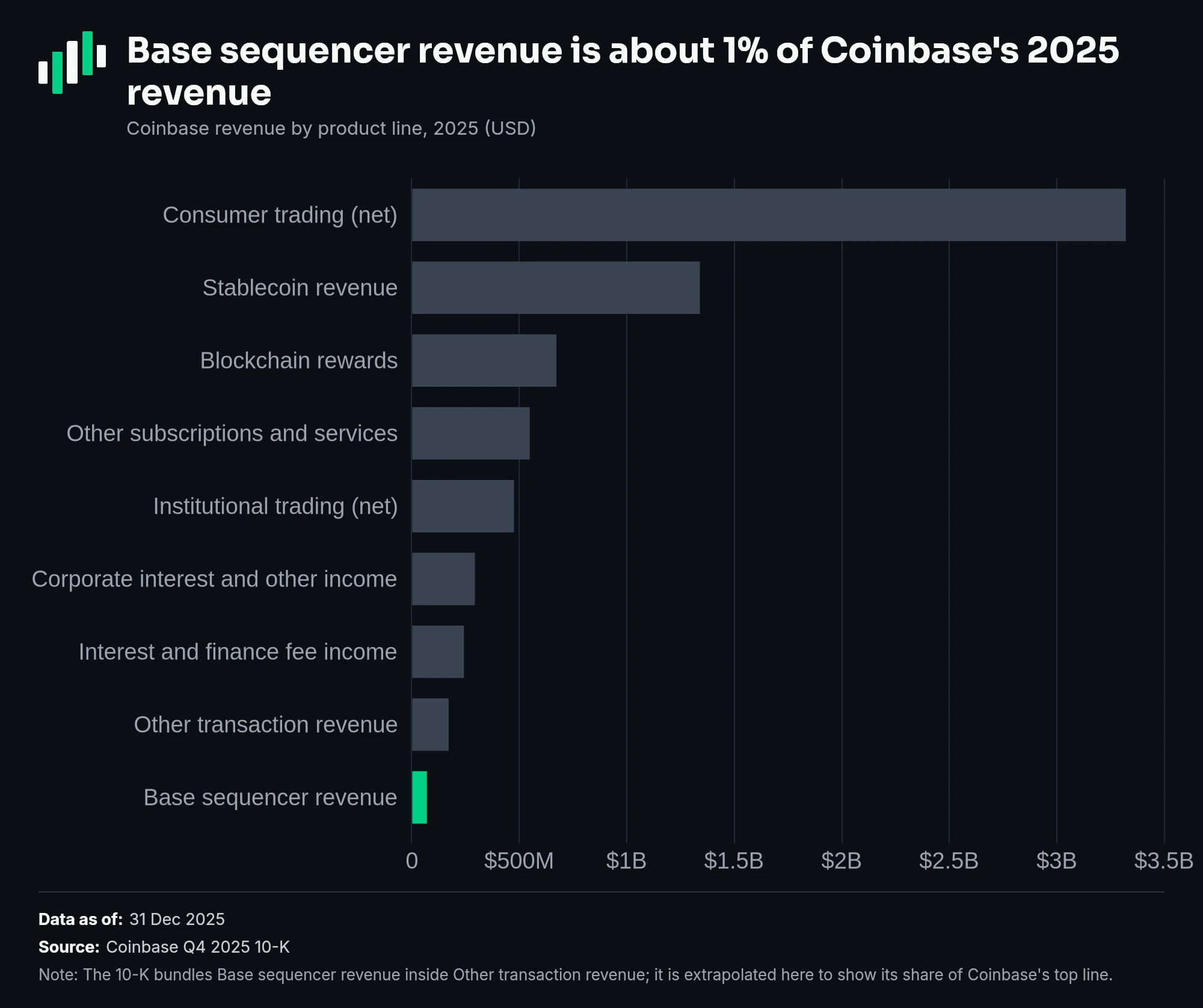
In Coinbase’s Q4 2025 shareholder letter, the company reported $7.2 billion in revenue for 2025. Consumer trading contributed $3.32 billion, stablecoin revenue reached $1.35 billion, blockchain staking rewards generated $677.4 million, and institutional trading added $479.7 million. Base’s $77.9 million in sequencer revenue represented 1.1% of the company’s top line.
If sequencer revenue were a material share of earnings, any token mechanism built around Base would create a zero-sum conflict with COIN shareholders. Its immateriality is what makes the recommended framework viable. The token economy operates on a separate plane, funded by protocol emissions and structural demand rather than corporate cash flow. The result is a business line that contributes 1.1% of revenue and can generate a balance sheet asset worth multiples of that contribution.
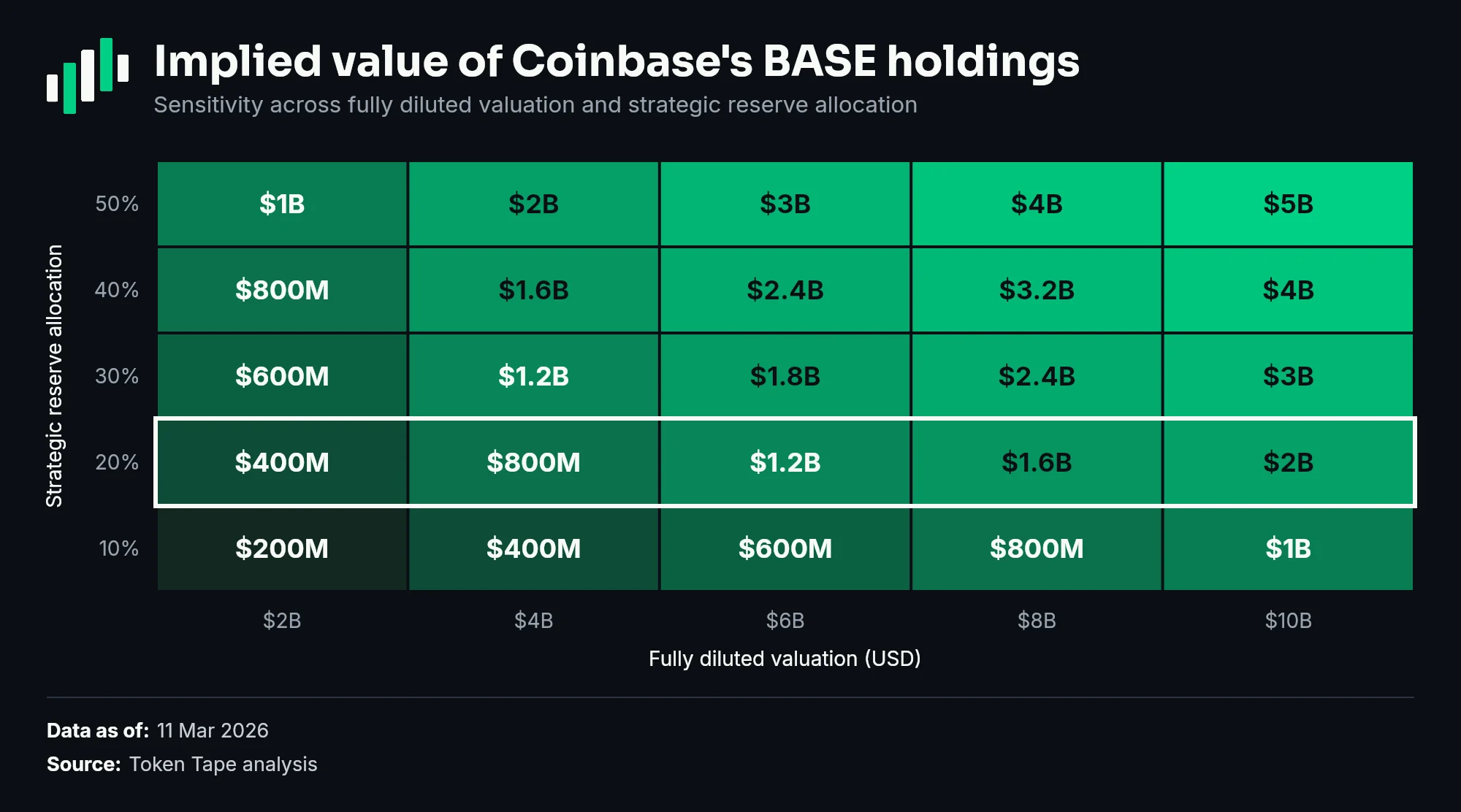
Polymarket's prediction market for BASE FDV, one day after launch, implied valuations across tiers ranging from $2 billion to $12 billion. The analysis caps at $10 billion because the $12 billion tier carries the lowest implied probability of any bucket, making it an outlier scenario that would distort the range. The sensitivity matrix maps each FDV tier against a range of strategic reserve allocations from 10% to 50%. Each cell represents the dollar value of Coinbase's BASE holdings at that intersection. The 20% row is highlighted as the recommended allocation, balancing meaningful balance-sheet impact against the concentration risk of a larger position in a single network asset. Reading across that row, Coinbase's reserve ranges from $400.0 million at a $2.00 billion FDV to $2.00 billion at $10.00 billion
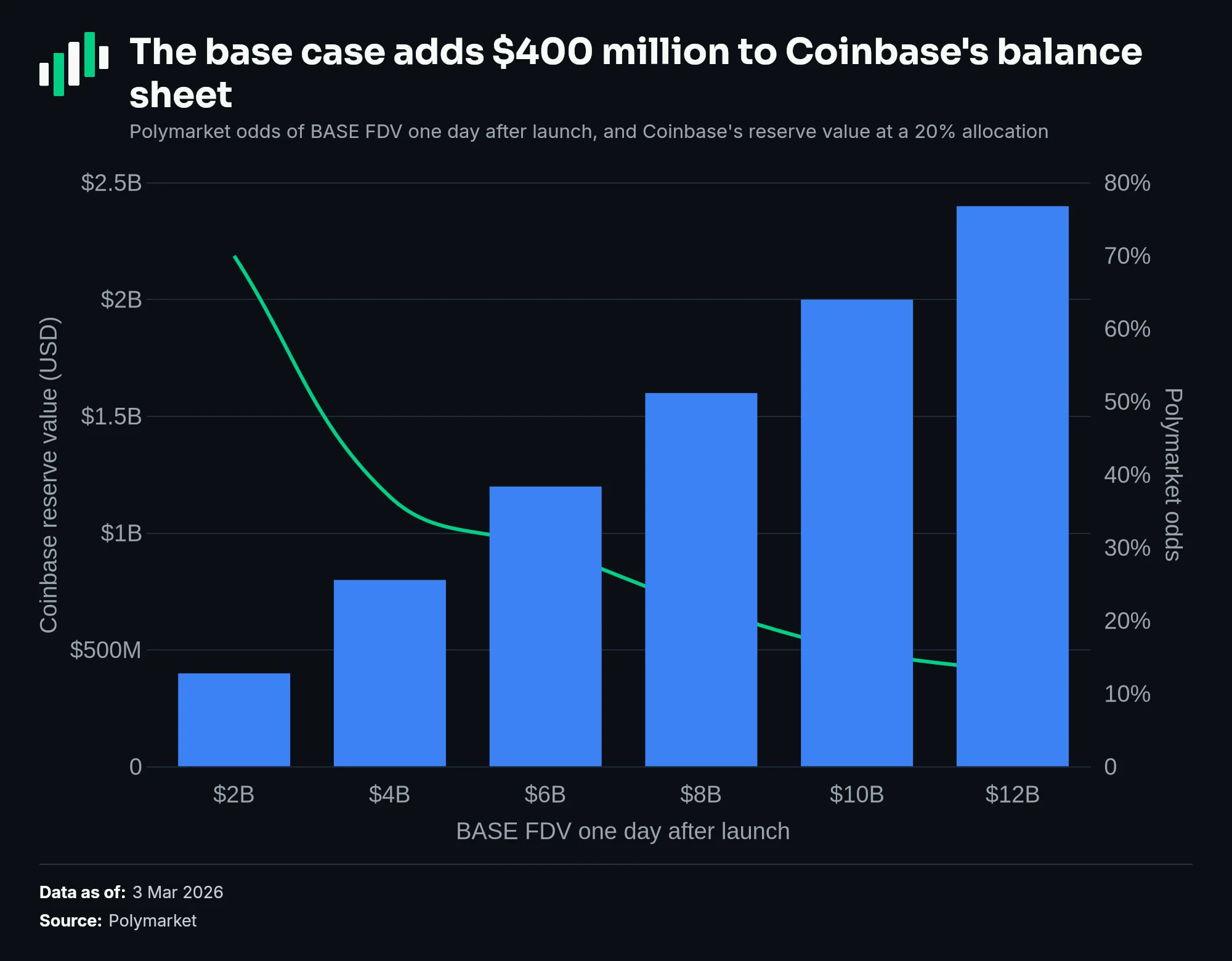
At the recommended 20% allocation and a $10 billion FDV, Coinbase's $51.9 billion market cap implies that a 1.1% revenue line would create 3.8% of equity value. Even at the low end of $2.00 billion FDV, a 20% allocation still adds $400.0 million to the balance sheet with zero dilution to existing revenue streams.
For COIN shareholders, BASE is not a distraction from the core business. It is the highest-leverage mechanism available to monetize the network effects that Coinbase has already built.
Closing Summary
Base is the largest Ethereum L2 by DeFi TVL, the highest revenue-generating rollup in the ecosystem, and the only major network without a native token. The SEC enforcement action against Coinbase was dismissed, the GENIUS Act is law, CLARITY is advancing, and the Superchain exit gave Coinbase full economic sovereignty over Base's revenue and governance. Polymarket prices a 47% probability of a launch by the end of 2026. The question for a BASE token is now when, not if.
The design space is constrained by Coinbase's obligations as a public company, but those constraints are what make the opportunity unique. A governance token replicates the failures of ARB, OP, and STRK. A revenue share creates shareholder conflict. A collateral-only model is too narrow, and a vote-escrow framework captures DeFi but misses the rest of the Base economy. The recommended four-pillar framework takes what works from each and discards what doesn't, pairing sequencer staking with token-weighted governance, network-wide utility, and a 20% strategic reserve that turns all of it into balance-sheet accretion for COIN.
Coinbase retains 100% of sequencer revenue, which accounts for 1.1% of the company's top line. The token economy operates on a separate plane, funded by protocol emissions and demand driven by staking, governance, and utility rather than corporate cash flow. There is no configuration of this framework in which BASE subtracts value from COIN. Instead, it adds multiples of that contribution in enterprise value.
Read Token Tape every morning.
The daily digital-asset briefing, from the same desk.