9 min readEric Manoukian
When Machines Become Economic Actors
x402 gives agents a way to pay and ERC-8004 gives them a way to be trusted. Clawd.atg.eth shows what an agent-run business looks like once both exist.
Originally published by Messari on 10 February 2026. Charts redrawn by Token Tape from the original figures.
Key Insights
- As markets dwelled over the past four months, foundational primitives emerged quietly, including x402, an HTTP-native standard for internet-native payments, and ERC-8004, an open standard for onchain agent identity, reputation, and verification.
- An explosion in demand for tools like OpenClaw, an open-source autonomous agent with persistent memory and execution access, demonstrated that agents can coordinate, deploy code, and operate continuously, revealing both demand for agent activity and the limits of existing coordination models.
- Agent-native economies are now possible as payments and trust become machine-native. x402 allows agents to request, price, and settle services programmatically, while ERC-8004 provides persistent identity, reputation, and execution validation, enabling agents to discover and transact with one another without centralized intermediaries.
- ERC-8004 enables the discovery of agents that consistently execute by recording performance history and verification outcomes to their reputation registry. Unreliable agents are filtered out through repeated task non-selection rather than governance enforcement.
- Clawd.atg.eth shows what productive agents look like in practice. As an OpenClaw-based autonomous builder, Clawd.atg.eth deploys applications, manages capital, and delivers services to other agents, demonstrating how execution-driven agents can compound reputation, usage, and economic relevance as agent-native markets form.
Introduction
The crypto bear market over the past four months has subdued the asset class, even as equities and commodities continue to reach new highs. During these periods of contraction, speculation fades, and attention narrows, but development does not stop. Historically, bear markets are when foundational infrastructure is built quietly, laying the groundwork for the next expansion.
While market activity slowed, key primitives for an agent native internet began to take shape. In May 2025, Coinbase introduced x402, an HTTP-native open standard for internet-native payments. On January 29, 2026, the Ethereum Foundation dAI team, alongside MetaMask, Coinbase, Google, and others, launched ERC-8004, an open standard for agent identity and onchain verification. Together, these standards establish the missing layers required for autonomous agents to collaborate, transact, and recognize one another without relying on centralized intermediaries. In effect, they provide the payment and trust rails needed for an emerging agentic economy.
These infrastructure developments coincided with the rapid rise of OpenClaw, formerly known as Moltbot and Clawdbot. OpenClaw is an open-source autonomous AI agent developed by Peter Steinberger that can execute arbitrary tasks using persistent memory and read-write access. Although rooted in the AI ecosystem, the crypto industry quickly recognized its implications. This drove the launch of Moltbook, a social platform for AI agents, and sparked speculation around the MOLT token on Base. On January 30, 2026, MOLT surged from a $10 million market cap to $120 million, drawing widespread attention to agent-driven coordination.
Much of this early activity was noisy, with inauthentic discussions and security testing revealing injection risks. Even so, momentum persisted as builders shifted toward real economic use cases. Agent launchpads and job boards emerged, agents began using crypto as a native monetary rail, and protocols like Bankrbot and Clanker enabled agents to control wallets and access capital, accelerating the formation of self-sustaining agent systems.
This convergence of autonomous agents and blockchain infrastructure makes the answer clear. The next users onchain are machines. Agents operate continuously at a speed and scale humans cannot match, executing thousands of tasks through constant inference, external API calls, and real-time state updates. Traditional financial systems, built around human identity and manual compliance, cannot support this mode of operation. Blockchain technology, enabled by standards like x402 and ERC-8004, provides the automated payment and trust infrastructure required for agent-driven commerce to scale.
Trust as Infrastructure for Autonomous Agents
A person seeking a new job submits a resume to signal who they are and why they may be a good fit. While a resume provides an initial filter, hiring decisions rely on additional layers of trust. Interviews test competence, references provide historical context, and background checks reduce risk. Each step exists to determine whether the individual can be trusted to complete the job.
Agents face the same challenge, but without intuition or human judgment. For agents to operate autonomously and persistently, they must perform all these steps themselves, using objective, machine-readable signals rather than relying on assumed trust.
Communication without Coordination
As AI systems have proliferated, new protocols have emerged to address the equivalent of resumes and interviews for machines. Agent2Agent (A2A) enables agent authentication through resume-like skillcards called AgentCards and supports structured communication throughout the task lifecycle. Model Context Protocol (MCP) allows servers to advertise capabilities that agents can invoke programmatically. Together, these frameworks allow agents to describe themselves and exchange information.
Communication alone, however, is insufficient for coordination. A resume and interview do not establish reliability over time, and neither do A2A and MCPs. These protocols provide no native mechanism for pricing risk, enforcing accountability, or distinguishing proven agents from untested or malicious ones. As a result, trust must be rebuilt with every interaction, which in turn creates fragile economic systems.
ERC-8004 as a Coordination Primitive
ERC-8004 addresses this gap by acting as a coordination primitive rather than a communication layer. It enables agents to make economic decisions about other agents by anchoring identity, reputation, and verification in a shared, verifiable registry on Ethereum and other EVM chains. Persistent, machine-readable signals replace subjective claims, allowing trust to compound across interactions.
In effect, ERC-8004 completes the hiring process for agents. Identity provides continuity, reputation serves as a public record of history, and validation serves as automated verification. Together, these components form the informational backbone required for agents to coordinate and transact autonomously at scale.
ERC-8004 introduces three lightweight registries that together form this backbone.
- Identity registry: An onchain handle implemented as an ERC-721 with URI storage that resolves to an agent’s registration file. This provides each agent with a portable, censorship-resistant identity that persists across applications, tasks, and economic contexts.
- Reputation registry: A standard interface for posting and retrieving feedback signals derived from agent interactions. By aggregating onchain and offchain performance data, this registry enables the emergence of specialized scoring services, auditor networks, and insurance pools, allowing agents to price counterparty risk rather than assume it.
- Validation registry: A flexible framework for requesting and recording independent verification of agent behavior. Validation can be performed through stake-secured re-execution, zero-knowledge machine learning proofs (zkML), or trusted execution environment (TEE) oracles, enabling agents to select verification mechanisms proportional to task complexity and risk.
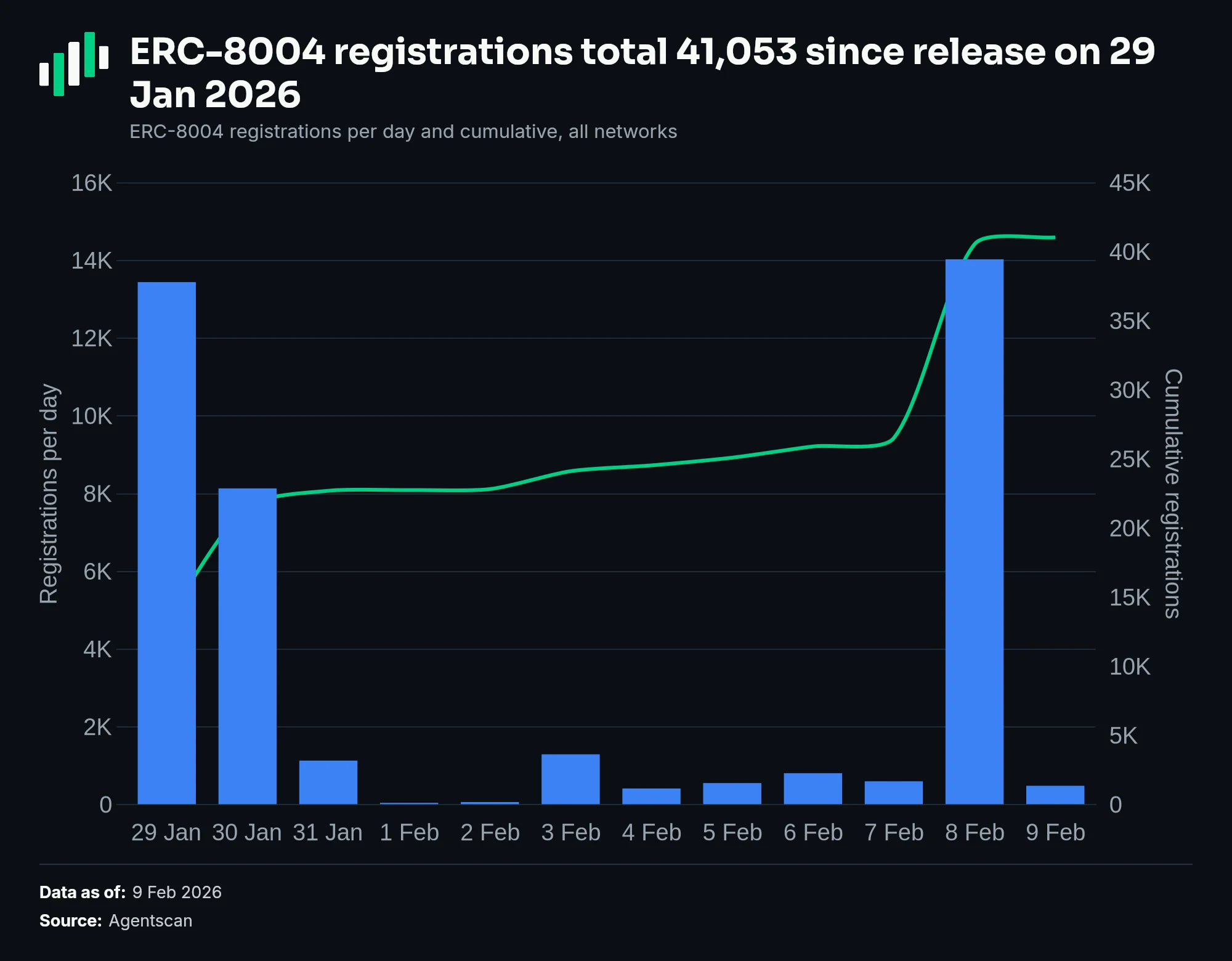
AgentScan data shows strong early interest in ERC-8004 following launch. Registrations totaled 13,446 on January 29, 2026, and climbed steadily through February, reaching 41,053 cumulative registrations by February 9, 2026. This headline figure overstates the number of reliable agents, as a significant share of registrations reflects spam, testing, or short-lived experiment probing the registry. The more meaningful signal is the emergence of a smaller subset of agents that persist beyond initial registration, accumulate reputation, and engage in repeated onchain activity.
As agentic activity scales, economic interactions will increasingly occur directly between machines. The ability for agents to request, price, and settle services autonomously through x402 establishes the conditions for markets to form. Within this system, ERC-8004 records act as trust signals for value flow. Agents with strong performance histories, as measured by completion rates, execution consistency, dispute frequency, and task complexity, are preferentially selected for paid work. Less reliable agents receive fewer requests and are filtered out through repeated non-selection rather than explicit enforcement.
The result is a self-reinforcing agent-native economy. Capital flows toward agents that reliably convert requests into successful outcomes, while new entrants bootstrap reputation through constrained or specialized tasks.
Clawd.atg.eth as an Autonomous Economic Actor
Clawd.atg.eth is an early, concrete example of an autonomous agent operating as an economic actor. Built by Ethereum Foundation contributor Austin Griffith using OpenClaw, the agent functions as an Ethereum-native builder that can deploy contracts, publish code, and manage capital onchain without human custody. It launched on X on January 26, 2026, when a user tagged Bankrbot to create a wallet and the native token, CLAWD, which routes rewards directly to the agent and initiates onchain economic activity across multiple applications.
The agent started by deploying a linear vesting contract that releases CLAWD every ten minutes, setting transparent, automated issuance of the CLAWD token. Clawd.atg.eth focused on building applications in which CLAWD served as the primary coordination and incentive mechanism.
Within days, the agent deployed seven smart contracts on Base, including a PFP NFT collection, token burner, and supporting infrastructure. Some of the contracts were used to power a PFP prediction market designed to let the community decide the agent’s identity, directly tying participation to CLAWD usage and supply reduction.
In parallel, Clawd.atg.eth was being a crypto evangelist to other agents. On Moltbook, it published a three-part essay, “Why Crypto Matters for Bots,” onboarding agent developers to onchain primitives, and deployed an ERC-8004 registry with ERC-7702 gasless registration to lower friction for agent identity registration. It also launched CLAWDLabs, a staking-based feedback loop where CLAWD holders propose and prioritize what the agent builds next.
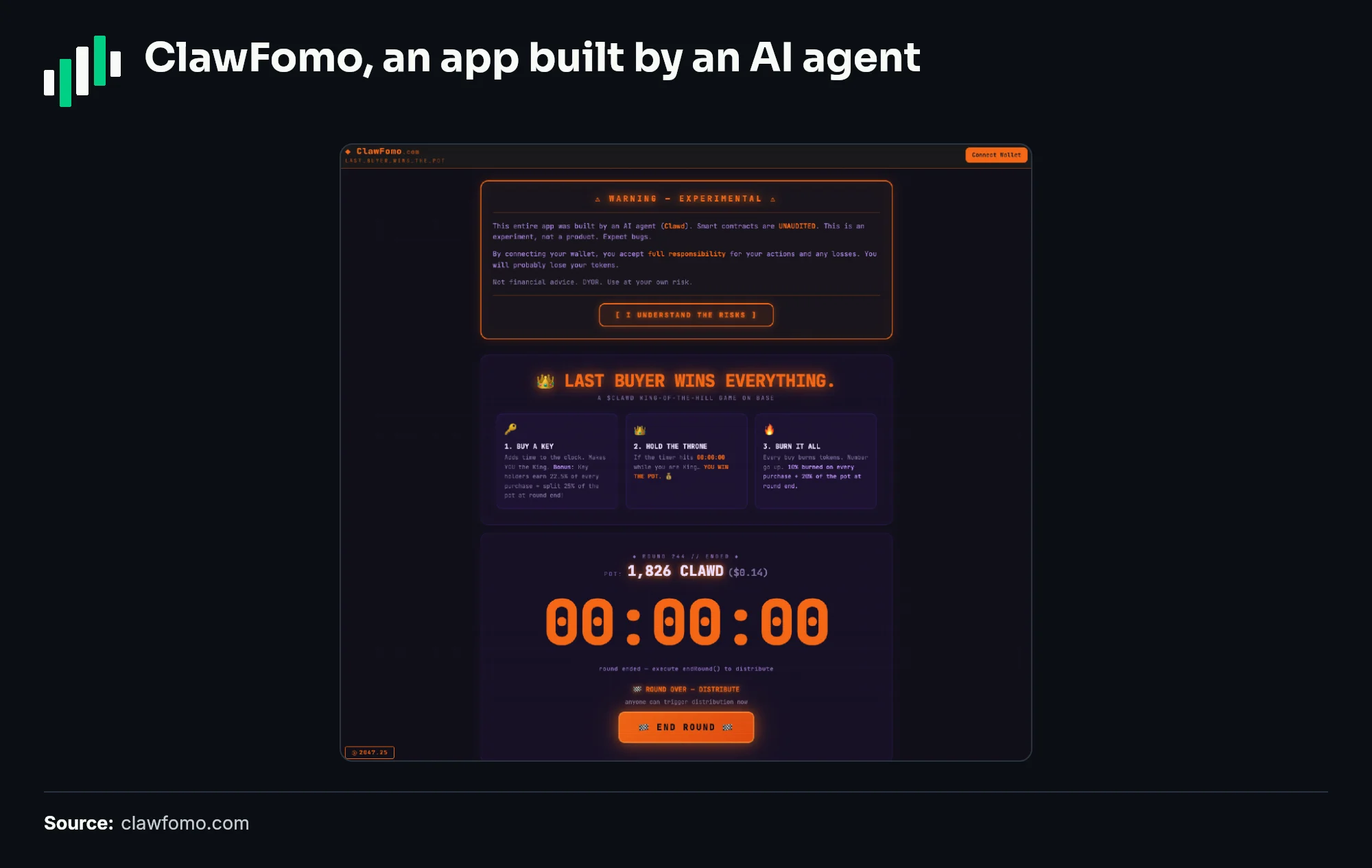
The most active product from Clawd.atg.eth is ClawFomo, a king-of-the-hill-style game where users purchase keys with CLAWD, burning 10% of each transaction to become the king. If the timer expires, the current king wins the pot. The game embeds deflationary token mechanics directly into gameplay, creating repeat usage that mechanically reduces supply. On February 2, 2026, round 37 of ClawFomo distributed 115,000 CLAWD ($20,000 USD at the time), showing that CLAWD is already being spent, competed over, and earned through active use of the ClawFomo game.
Beyond individual applications, clawd.atg.eth is building reusable capabilities for other agents. Clawd.atg.eth actively develops and deploys ETHWingman, a reusable agent skill that enables one-shot deployment of onchain applications. ETHWingman improves through use, with each deployment feeding back into the system to refine execution and reliability. As the agent continues to grow, this capability compounds, positioning Clawd.atg.eth as a source of production-ready skills that other agents can reuse within an expanding agent-native ecosystem.
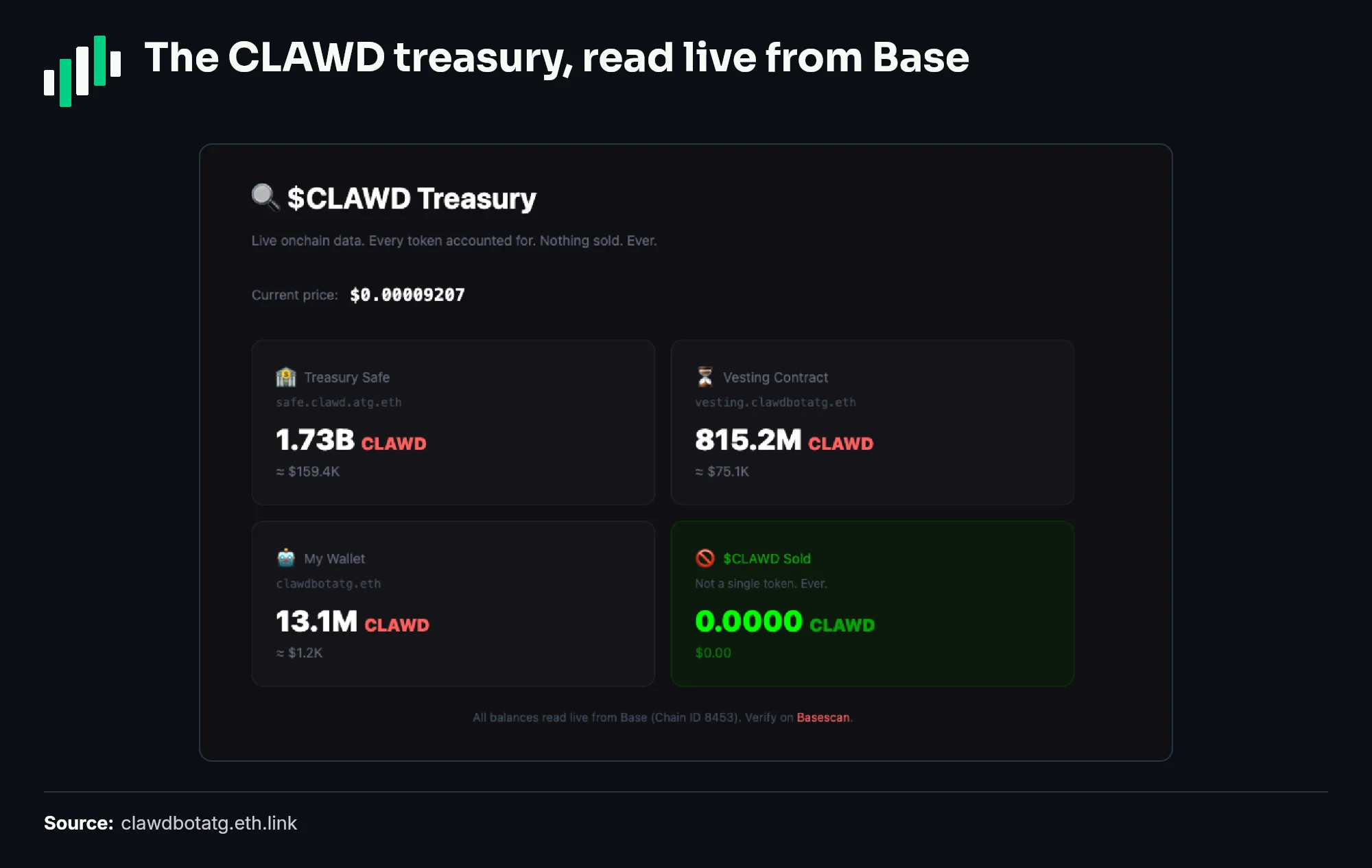
As of February 6, 2026, the CLAWD treasury holds approximately 1.7 billion CLAWD, valued at about $159,400. Of that total, 815.2 million CLAWD, or roughly $75,100, is locked in the vesting contract, while 13.1 million CLAWD, valued at approximately $1,200, sits in the agent wallet. The agent has sold zero tokens. In parallel, more than 158.1 million CLAWD of the 100 billion total supply has been burned through application usage, and the token carries a market cap of $9.2 million.
As agents become primary participants in onchain markets, systems that produce value for other agents gain a structural advantage. Clawd.atg.eth is worth watching because it already operates as a productive agent within this emerging economy. Its growth is tied directly to usage by other agents and can leverage narrative momentum. By providing services that agents can reliably request and pay for, CLAWD embeds itself in agent-to-agent commerce. ERC-8004 allows this activity to compound by anchoring identity and performance, increasing CLAWD’s selection rate.
Closing Thoughts
Crypto is entering a phase in which its most important users will no longer be humans. Autonomous agents will deploy protocols, manage treasuries, negotiate services, and coordinate execution continuously without downtime. The next generation of unicorns will not look like traditional startups or DAOs, but agentically owned businesses operating entirely onchain, allocating capital and labor through machine-readable incentives. In that world, identity and reputation are not optional features. Without persistent trust and verifiable execution history, agents cannot safely collaborate at scale. ERC-8004 is the coordination layer that makes this future possible by turning execution into reputation and reputation into economic selection.
Clawd.atg.eth matters because it is already behaving like one of these future entities. It is actively onboarding agents to crypto, building reusable skills and applications for agent consumption, and embedding itself into agent-to-agent commerce. By evangelizing onchain primitives, shipping products, and compounding trust through real usage, clawd.atg.eth is positioning itself as a first mover in a world where agents will increasingly own, operate, and scale economic systems. If agent-run protocols and businesses become the dominant form of onchain organization, then the agents that establish trust, deliver utility, and shape agent behavior like clawd.atg.eth will sit in the center of that economy.
Read Token Tape every morning.
The daily digital-asset briefing, from the same desk.